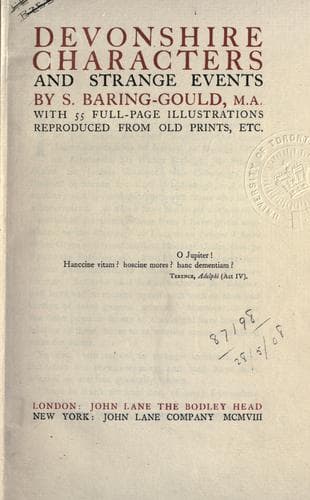
Devonshire Characters and Strange EventsBaring-Gould, S. (Sabine)
History
Devonshire Characters and Strange Events
Baring-Gould, S. (Sabine)
Devon (England) -- Biography; Devon (England) -- History
B. R.’s father had been a fast and dissipated man, but before he
utterly sank past recovery, he pulled himself together and became
a man of business, always somewhat shifty, and disposed to enjoy
himself rather than stick to work. On one occasion the bookseller
was asked angrily by a important customer why he had not fulfilled
his oft-repeated promise to procure some young walnuts to which he
had access, and his reply was that there had been such a demand for
gun-stocks from the war then raging in the Peninsula that there were no
trees left.
A somewhat congenial spirit came to Plymouth and settled into his
house. This was a Mr. Cobley, brother of Mrs. Haydon, a man fond of
society and of his bottle, accomplished, and so habitually indolent
that when he came to see his sister on a six weeks’ visit he never had
the energy to remove, got embedded in the family, stayed thirty years,
and quitted it and life together.
B. R. does not appear to have had much love for his father, but he
always speaks of his mother with the tenderest affection, and _her_
opposition to her only boy’s choice of the profession of a painter cost
him a severe struggle before he could disregard her entreaties to abide
by his father’s trade.
Haydon was little more than a boy in years when he left home in May,
1804, and plunged into the uncertain depths of London life. He had an
introduction to Northcote, a Devonshire man like himself, but jealous,
spiteful, and unwilling to help a struggling beginner. And he was
fortunate in attracting the notice of Fuseli, Keeper of the Royal
Academy, who liked him, and helped him to master the rudiments of his
profession.
Haydon admired the effects of London smoke.
“By Gode,” said Fuseli to him one day, “it’s like the smoke of the
Israelites making bricks.” “It is grand,” retorted B. R., “for it is
the smoke of a people who would have made the Egyptians make bricks for
them.”
He became friendly with Wilkie, then a raw, red-headed Scotch lad,
who had made a hit, and taken the town by storm with his “Village
Politicians.”
David Wilkie was canny about money. One day he was showing his fellow
pupils some drawing-paper he was using. “Why, Wilkie!” exclaimed
Haydon, “where did you get this? Bring us a quire to-morrow.”
He promised that he would. The next day, and the day after, no
drawing-paper. When remonstrated with, David quietly excused himself,
“Weel, weel, jest give me the money first, and ye’ll be sure to hae the
paper.”
When thus starting as a painter, a hint was given to Haydon, by this
success of Wilkie, what was the line that he should pursue, what was
the style of picture that would appeal to the public. But he was too
obstinate to take the hint. His idea was the High Art, heroic subjects
from mythology or classic history, or from the Old Testament, on huge
canvases--themes that interested few, and of a size that few could buy.
Public-domain text, read in full here on John Shaqi.
Reviews
Reviews
No reviews yet
Be the first to share your thoughts on this work.
Elsewhere in the archive
Join the Discussion
Join the discussion
Sign in to leave a comment or review.
Sign InorCreate an account