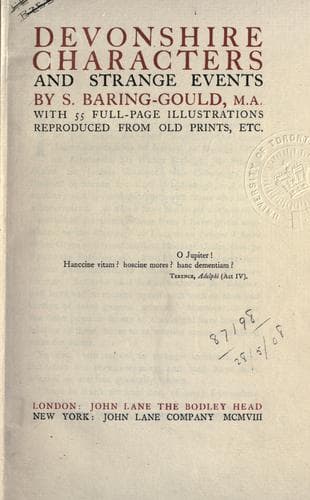
Devonshire Characters and Strange EventsBaring-Gould, S. (Sabine)
History
Devonshire Characters and Strange Events
Baring-Gould, S. (Sabine)
Devon (England) -- Biography; Devon (England) -- History
“My sister, hanging over my poor mother, wept painfully. She, Cross,
my uncle and aunt, were all sobbing and much touched; for my part, my
chest hove up and down as I struggled with emotions at this singular
and afflicting meeting. Disappointment in love, where the character is
amiable, gives a pathetic interest to woman or man. But how much more
than ordinary sympathy must he excite who, dumb by nature, can only
express his feelings by the lightenings of the eye! Thus had this man
been left for thirty years, brooding over affections wounded as for
the mere pleasure of torture. For many months after my mother married
he was frantic and ungovernable at her continued absence, and then
sank into sullen sourness. His relations and friends endeavoured to
explain to him the cause of her going away, but he was never satisfied,
and never believed them; now, when the recollection of her, young
and beautiful, might occasionally have soothed his imagination, she
suddenly bursts on him with two children, the offspring of her marriage
with his rival--and that so altered, bowed, and weakened as to root
out the association of her youthful beauty with the days of his happy
thoughts.
“There are moments of suffering or joy when all thought of human
frailties is swept away in the gush of sympathy. Such a moment was
this. His anger, his frantic indignation, and his sullen silence at her
long absence, all passed away before her worn and sickly face. He saw
her before him, broken and dying; he felt all his affection return,
and flinging himself forward on the table, he burst into a paroxysm of
tears as if his very heart-strings would crack. By degrees we calmed
him, for nature had been relieved by this agonizing grief, and they
parted in a few moments for the last time.”
Next day Haydon and his sister went on with their mother, but did not
reach London with her; she died at Salt Hill, in the inn.
Surely had B. R. but deigned to paint a picture of the old dumb
lover with arms outspread on the table, weeping--as he so touchingly
describes the scene, it would have appealed to the public. But no! the
scene was not heroic. Old Cross was not a classic figure. Haydon had
resolved to be a painter of heroic in art or be nothing.
Public-domain text, read in full here on John Shaqi.
Reviews
Reviews
No reviews yet
Be the first to share your thoughts on this work.
Elsewhere in the archive
Join the Discussion
Join the discussion
Sign in to leave a comment or review.
Sign InorCreate an account