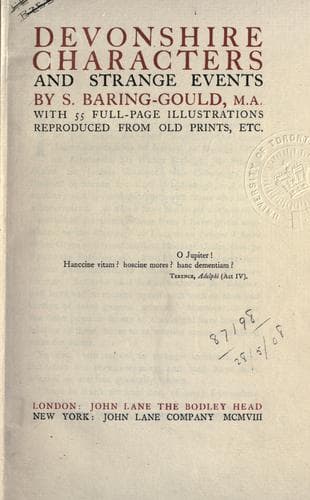
Devonshire Characters and Strange EventsBaring-Gould, S. (Sabine)
History
Devonshire Characters and Strange Events
Baring-Gould, S. (Sabine)
Devon (England) -- Biography; Devon (England) -- History
Besides having done much for his King and country, Cooke flattered
himself that he did much for the city of Exeter. He says: “We are
indebted to Mr. S. F. Milford for the Savings Bank, and wholesome
prisons in Exeter. We had no common sewers until 1810, it was like
old Edinburgh before. About twelve years since, I rose one morning
before the people were up, and numbered every house in Fore Street with
chalk, which made the people stare. I was told I had not begun at the
right end, with the sun. I went over the ground again. My house being
a corner one, I got it properly numbered, and the street labelled,
which soon led to be general. I paid for seven label boards at the
street. Who would have done it beside? Our market days had ever been
on Wednesdays and Fridays, only one day between. I wrote a requisition
on the propriety of altering the Wednesday’s market to Tuesday. I
carried it for signatures to the principal inhabitants, and sent it
to the Chamber, who upon perusing of their charters found they had a
bye-law; the market was altered with unanimous approbation in 1812.”
He also introduced watering-carts for the streets in summer. In 1809
he issued a catalogue of a hundred and ten nuisances in the city of
Exeter, which he exhorted the Corporation to get rid of. He urged on
the Dean and Chapter the pulling down of the gates into the Close,
which unhappily was done. “At present,” said Cooke, “you have none but
a dangerous way to the Cathedral. A coach-passenger was killed going
under Catherine-Gate.”
There were still three gates left; three had already been destroyed.
Poor Allhallows, Goldsmith Street, was levelled with the dust but last
year, so as to widen High Street. Cooke urged its destruction in 1809,
as “useless and dormant.”
Cooke built himself a villa residence, which he dubbed “Waterloo
Cottage.” He was a very plain man, with thick, coarse mouth, and a
broken nose. A portrait, a profile, is prefixed to his pamphlet, _Old
England for Ever_, but there is one much finer of him, in colour,
representing him in uniform. This is in the library of the Institution
at Exeter.
That the man had enormous self-confidence and conceit _saute aux yeux_,
but that he was a useful man to his country, to the county, and to the
city is also clear.
Cooke assures us that he had been in 400 out of the 466 parishes of
Devon, “having the heartfelt satisfaction of being respected” in all
of them, “and knowing fifteen lords, four honourables, twenty-two
baronets, and three knights, and most of the clergy and gentry” of the
county.
Public-domain text, read in full here on John Shaqi.
Reviews
Reviews
No reviews yet
Be the first to share your thoughts on this work.
Elsewhere in the archive
Join the Discussion
Join the discussion
Sign in to leave a comment or review.
Sign InorCreate an account