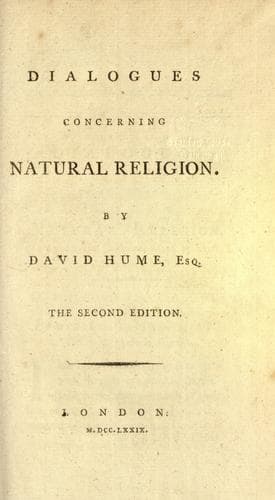
Natural theology -- Early works to 1800; Religion -- Early works to 1800
Did I show you a house or palace, where there was not one apartment
convenient or agreeable; where the windows, doors, fires, passages,
stairs, and the whole economy of the building, were the source of noise,
confusion, fatigue, darkness, and the extremes of heat and cold; you
would certainly blame the contrivance, without any further examination.
The architect would in vain display his subtlety, and prove to you, that
if this door or that window were altered, greater ills would ensue. What
he says may be strictly true: The alteration of one particular, while the
other parts of the building remain, may only augment the inconveniences.
But still you would assert in general, that, if the architect had had
skill and good intentions, he might have formed such a plan of the whole,
and might have adjusted the parts in such a manner, as would have
remedied all or most of these inconveniences. His ignorance, or even your
own ignorance of such a plan, will never convince you of the
impossibility of it. If you find any inconveniences and deformities in
the building, you will always, without entering into any detail, condemn
the architect.
In short, I repeat the question: Is the world, considered in general, and
as it appears to us in this life, different from what a man, or such a
limited being, would, beforehand, expect from a very powerful, wise, and
benevolent Deity? It must be strange prejudice to assert the contrary.
And from thence I conclude, that however consistent the world may be,
allowing certain suppositions and conjectures, with the idea of such a
Deity, it can never afford us an inference concerning his existence. The
consistence is not absolutely denied, only the inference. Conjectures,
especially where infinity is excluded from the Divine attributes, may
perhaps be sufficient to prove a consistence, but can never be
foundations for any inference.
There seem to be four circumstances, on which depend all, or the greatest
part of the ills, that molest sensible creatures; and it is not
impossible but all these circumstances may be necessary and unavoidable.
We know so little beyond common life, or even of common life, that, with
regard to the economy of a universe, there is no conjecture, however
wild, which may not be just; nor any one, however plausible, which may
not be erroneous. All that belongs to human understanding, in this deep
ignorance and obscurity, is to be sceptical, or at least cautious, and
not to admit of any hypothesis whatever, much less of any which is
supported by no appearance of probability. Now, this I assert to be the
case with regard to all the causes of evil, and the circumstances on
which it depends. None of them appear to human reason in the least degree
necessary or unavoidable; nor can we suppose them such, without the
utmost license of imagination.
Public-domain text, read in full here on John Shaqi.
Reviews
Reviews
No reviews yet
Be the first to share your thoughts on this work.
Elsewhere in the archive
Join the Discussion
Join the discussion
Sign in to leave a comment or review.
Sign InorCreate an account