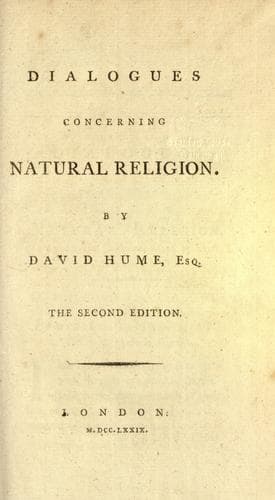
Natural theology -- Early works to 1800; Religion -- Early works to 1800
My sentiments, replied PHILO, are not worth being made a mystery of; and
therefore, without any ceremony, I shall deliver what occurs to me with
regard to the present subject. It must, I think, be allowed, that if a
very limited intelligence, whom we shall suppose utterly unacquainted
with the universe, were assured, that it were the production of a very
good, wise, and powerful Being, however finite, he would, from his
conjectures, form beforehand a different notion of it from what we find
it to be by experience; nor would he ever imagine, merely from these
attributes of the cause, of which he is informed, that the effect could
be so full of vice and misery and disorder, as it appears in this life.
Supposing now, that this person were brought into the world, still
assured that it was the workmanship of such a sublime and benevolent
Being; he might, perhaps, be surprised at the disappointment; but would
never retract his former belief, if founded on any very solid argument;
since such a limited intelligence must be sensible of his own blindness
and ignorance, and must allow, that there may be many solutions of those
phenomena, which will for ever escape his comprehension. But supposing,
which is the real case with regard to man, that this creature is not
antecedently convinced of a supreme intelligence, benevolent, and
powerful, but is left to gather such a belief from the appearances of
things; this entirely alters the case, nor will he ever find any reason
for such a conclusion. He may be fully convinced of the narrow limits of
his understanding; but this will not help him in forming an inference
concerning the goodness of superior powers, since he must form that
inference from what he knows, not from what he is ignorant of. The more
you exaggerate his weakness and ignorance, the more diffident you render
him, and give him the greater suspicion that such subjects are beyond the
reach of his faculties. You are obliged, therefore, to reason with him
merely from the known phenomena, and to drop every arbitrary supposition
or conjecture.
Public-domain text, read in full here on John Shaqi.
Reviews
Reviews
No reviews yet
Be the first to share your thoughts on this work.
Elsewhere in the archive
Join the Discussion
Join the discussion
Sign in to leave a comment or review.
Sign InorCreate an account