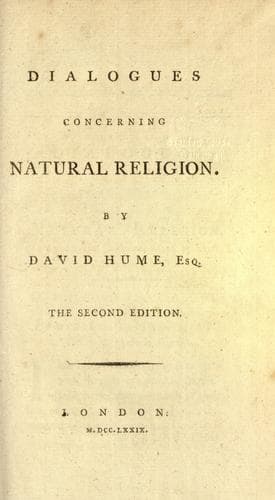
Natural theology -- Early works to 1800; Religion -- Early works to 1800
And so will all religion, said PHILO, except the philosophical and
rational kind. Your reasonings are more easily eluded than my facts. The
inference is not just, because finite and temporary rewards and
punishments have so great influence, that therefore such as are infinite
and eternal must have so much greater. Consider, I beseech you, the
attachment which we have to present things, and the little concern which
we discover for objects so remote and uncertain. When divines are
declaiming against the common behaviour and conduct of the world, they
always represent this principle as the strongest imaginable (which indeed
it is); and describe almost all human kind as lying under the influence
of it, and sunk into the deepest lethargy and unconcern about their
religious interests. Yet these same divines, when they refute their
speculative antagonists, suppose the motives of religion to be so
powerful, that, without them, it were impossible for civil society to
subsist; nor are they ashamed of so palpable a contradiction. It is
certain, from experience, that the smallest grain of natural honesty and
benevolence has more effect on men's conduct, than the most pompous views
suggested by theological theories and systems. A man's natural
inclination works incessantly upon him; it is for ever present to the
mind, and mingles itself with every view and consideration: whereas
religious motives, where they act at all, operate only by starts and
bounds; and it is scarcely possible for them to become altogether
habitual to the mind. The force of the greatest gravity, say the
philosophers, is infinitely small, in comparison of that of the least
impulse: yet it is certain, that the smallest gravity will, in the end,
prevail above a great impulse; because no strokes or blows can be
repeated with such constancy as attraction and gravitation.
Another advantage of inclination: It engages on its side all the wit and
ingenuity of the mind; and when set in opposition to religious
principles, seeks every method and art of eluding them: In which it is
almost always successful. Who can explain the heart of man, or account
for those strange salvos and excuses, with which people satisfy
themselves, when they follow their inclinations in opposition to their
religious duty? This is well understood in the world; and none but fools
ever repose less trust in a man, because they hear, that from study and
philosophy, he has entertained some speculative doubts with regard to
theological subjects. And when we have to do with a man, who makes a
great profession of religion and devotion, has this any other effect upon
several, who pass for prudent, than to put them on their guard, lest they
be cheated and deceived by him?
Public-domain text, read in full here on John Shaqi.
Reviews
Reviews
No reviews yet
Be the first to share your thoughts on this work.
Elsewhere in the archive
Join the Discussion
Join the discussion
Sign in to leave a comment or review.
Sign InorCreate an account