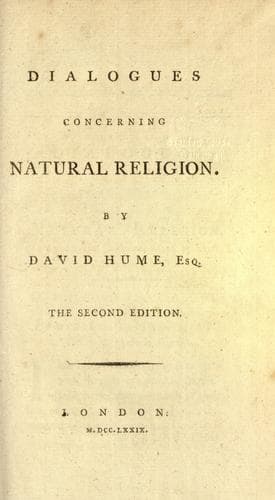
Natural theology -- Early works to 1800; Religion -- Early works to 1800
If the whole of Natural Theology, as some people seem to maintain,
resolves itself into one simple, though somewhat ambiguous, at least
undefined proposition, That the cause or causes of order in the universe
probably bear some remote analogy to human intelligence: If this
proposition be not capable of extension, variation, or more particular
explication: If it affords no inference that affects human life, or can
be the source of any action or forbearance: And if the analogy, imperfect
as it is, can be carried no further than to the human intelligence, and
cannot be transferred, with any appearance of probability, to the other
qualities of the mind; if this really be the case, what can the most
inquisitive, contemplative, and religious man do more than give a plain,
philosophical assent to the proposition, as often as it occurs, and
believe that the arguments on which it is established exceed the
objections which lie against it? Some astonishment, indeed, will
naturally arise from the greatness of the object; some melancholy from
its obscurity; some contempt of human reason, that it can give no
solution more satisfactory with regard to so extraordinary and
magnificent a question. But believe me, CLEANTHES, the most natural
sentiment which a well-disposed mind will feel on this occasion, is a
longing desire and expectation that Heaven would be pleased to dissipate,
at least alleviate, this profound ignorance, by affording some more
particular revelation to mankind, and making discoveries of the nature,
attributes, and operations of the Divine object of our faith. A person,
seasoned with a just sense of the imperfections of natural reason, will
fly to revealed truth with the greatest avidity: While the haughty
Dogmatist, persuaded that he can erect a complete system of Theology by
the mere help of philosophy, disdains any further aid, and rejects this
adventitious instructor. To be a philosophical Sceptic is, in a man of
letters, the first and most essential step towards being a sound,
believing Christian; a proposition which I would willingly recommend to
the attention of PAMPHILUS: And I hope CLEANTHES will forgive me for
interposing so far in the education and instruction of his pupil.
CLEANTHES and PHILO pursued not this conversation much further: and as
nothing ever made greater impression on me, than all the reasonings of
that day, so I confess, that, upon a serious review of the whole, I
cannot but think, that PHILO's principles are more probable than DEMEA's;
but that those of CLEANTHES approach still nearer to the truth.
Public-domain text, read in full here on John Shaqi.
Reviews
Reviews
No reviews yet
Be the first to share your thoughts on this work.
Elsewhere in the archive
Join the Discussion
Join the discussion
Sign in to leave a comment or review.
Sign InorCreate an account