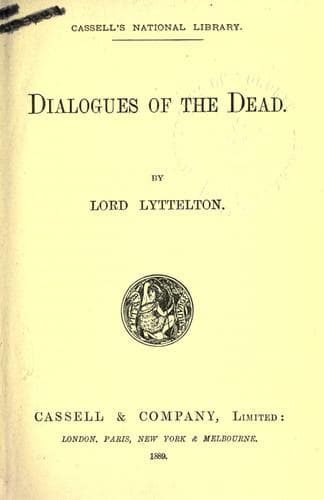
Dialogues of the DeadLyttelton, George Lyttelton, Baron
Philosophy
Dialogues of the Dead
Lyttelton, George Lyttelton, Baron
Dialogues, English -- Early works to 1800; Imaginary conversations
Upon the whole, as much as wealth is preferable to poverty, liberty to
oppression, and national strength to national weakness, so much has
Scotland incontestably gained by the union. England, too, has secured by
it every public blessing which was before enjoyed by her, and has greatly
augmented her strength. The martial spirit of the Scotch, their hardy
bodies, their acute and vigorous minds, their industry, their activity,
are now employed to the benefit of the whole island. He is now a bad
Scotchman who is not a good Englishman, and he is a bad Englishman who is
not a good Scotchman. Mutual intercourse, mutual interests, mutual
benefits, must naturally be productive of mutual affection. And when
that is established, when our hearts are sincerely united, many great
things, which some remains of jealousy and distrust, or narrow local
partialities, may hitherto have obstructed, will be done for the good of
the whole United Kingdom. How much may the revenues of Great Britain be
increased by the further increase of population, of industry, and of
commerce in Scotland! What a mighty addition to the stock of national
wealth will arise from the improvement of our most northern counties,
which are infinitely capable of being improved! The briars and thorns
are in a great measure grubbed up; the flowers and fruits may soon be
planted. And what more pleasing, or what more glorious employment can
any government have, than to attend to the cultivating of such a
plantation?
_Douglas_.--The prospect you open to me of happiness to my country
appears so fair, that it makes me amends for the pain with which I
reflect on the times wherein I lived, and indeed on our whole history for
several ages.
_Argyle_.--That history does, in truth, present to the mind a long series
of the most direful objects, assassinations, rebellions, anarchy,
tyranny, and religion itself, either cruel, or gloomy and unsocial. An
historian who would paint it in its true colours must take the pencil of
Guercino or Salvator Rosa. But the most agreeable imagination can hardly
figure to itself a more pleasing scene of private and public felicity
than will naturally result from the union, if all the prejudices against
it, and all distinctions that may tend on either side to keep up an idea
of separate interests, or to revive a sharp remembrance of national
animosities, can be removed.
_Douglas_.--If they can be removed! I think it impossible they can be
retained. To resist the union is indeed to rebel against Nature. She
has joined the two countries, has fenced them both with the sea against
the invasion of all other nations, but has laid them entirely open the
one to the other. Accursed be he who endeavours to divide them. What
God has joined let no man put asunder.
DIALOGUE XXVI.
CADMUS--HERCULES.
Public-domain text, read in full here on John Shaqi.
Reviews
Reviews
No reviews yet
Be the first to share your thoughts on this work.
Elsewhere in the archive
Join the Discussion
Join the discussion
Sign in to leave a comment or review.
Sign InorCreate an account