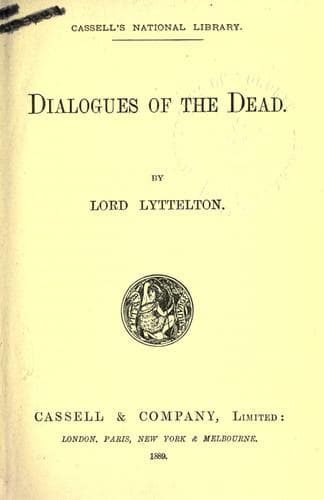
Dialogues of the DeadLyttelton, George Lyttelton, Baron
Philosophy
Dialogues of the Dead
Lyttelton, George Lyttelton, Baron
Dialogues, English -- Early works to 1800; Imaginary conversations
_Mrs. Modish_.--I did not mean to insist on any engagement with my
husband and children; I never thought myself engaged to them. I had no
engagements but such as were common to women of my rank. Look on my
chimney-piece, and you will see I was engaged to the play on Mondays,
balls on Tuesdays, the opera on Saturdays, and to card assemblies the
rest of the week, for two months to come; and it would be the rudest
thing in the world not to keep my appointments. If you will stay for me
till the summer season, I will wait on you with all my heart. Perhaps
the Elysian fields may be less detestable than the country in our world.
Pray have you a fine Vauxhall and Ranelagh? I think I should not dislike
drinking the Lethe waters when you have a full season.
_Mercury_.--Surely you could not like to drink the waters of oblivion,
who have made pleasure the business, end, and aim of your life! It is
good to drown cares, but who would wash away the remembrance of a life of
gaiety and pleasure.
_Mrs. Modish_.--Diversion was indeed the business of my life, but as to
pleasure, I have enjoyed none since the novelty of my amusements was gone
off. Can one be pleased with seeing the same thing over and over again?
Late hours and fatigue gave me the vapours, spoiled the natural
cheerfulness of my temper, and even in youth wore away my youthful
vivacity.
_Mercury_.--If this way of life did not give you pleasure, why did you
continue in it? I suppose you did not think it was very meritorious?
_Mrs. Modish_.--I was too much engaged to think at all: so far indeed my
manner of life was agreeable enough. My friends always told me
diversions were necessary, and my doctor assured me dissipation was good
for my spirits; my husband insisted that it was not, and you know that
one loves to oblige one's friends, comply with one's doctor, and
contradict one's husband; and besides I was ambitious to be thought _du
bon ton_.
_Mercury_.--_Bon ton_! what is that, madam? Pray define it.
_Mrs. Modish_.--Oh sir, excuse me, it is one of the privileges of the
_bon ton_ never to define, or be defined. It is the child and the parent
of jargon. It is--I can never tell you what it is: but I will try to
tell you what it is not. In conversation it is not wit; in manners it is
not politeness; in behaviour it is not address; but it is a little like
them all. It can only belong to people of a certain rank, who live in a
certain manner, with certain persons, who have not certain virtues, and
who have certain vices, and who inhabit a certain part of the town. Like
a place by courtesy, it gets a higher rank than the person can claim, but
which those who have a legal title to precedency dare not dispute, for
fear of being thought not to understand the rules of politeness. Now,
sir, I have told you as much as I know of it, though I have admired and
aimed at it all my life.
Public-domain text, read in full here on John Shaqi.
Reviews
Reviews
No reviews yet
Be the first to share your thoughts on this work.
Elsewhere in the archive
Join the Discussion
Join the discussion
Sign in to leave a comment or review.
Sign InorCreate an account