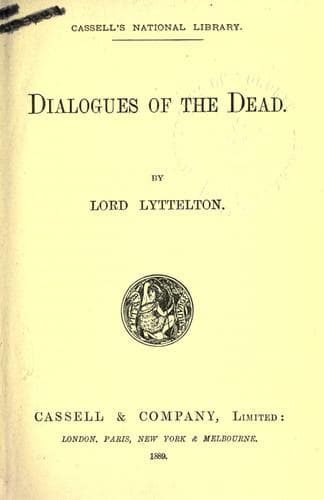
Dialogues of the DeadLyttelton, George Lyttelton, Baron
Philosophy
Dialogues of the Dead
Lyttelton, George Lyttelton, Baron
Dialogues, English -- Early works to 1800; Imaginary conversations
_Caesar_.--You talk finely, Africanus; but ask yourself, whether the
height and dignity of your mind--that noble pride which accompanies the
magnanimity of a hero--could always stoop to a nice conformity with the
laws of your country? Is there a law of liberty more essential, more
sacred, than that which obliges every member of a free community to
submit himself to a trial, upon a legal charge brought against him for a
public misdemeanour? In what manner did you answer a regular accusation
from a tribune of the people, who charged you with embezzling the money
of the State? You told your judges that on that day you had vanquished
Hannibal and Carthage, and bade them follow you to the temples to give
thanks to the gods. Nor could you ever be brought to stand a legal
trial, or justify those accounts, which you had torn in the senate when
they were questioned there by two magistrates in the name of the Roman
people. Was this acting like the subject of a free State? Had your
victory procured you an exemption from justice? Had it given into your
hands the money of the republic without account? If it had, you were
king of Rome. Pharsalia, Thapsus, and Munda could do no more for me.
_Scipio_.--I did not question the right of bringing me to a trial, but I
disdained to plead in vindication of a character so unspotted as mine. My
whole life had been an answer to that infamous charge.
_Caesar_.--It may be so; and, for my part, I admire the magnanimity of
your behaviour. But I should condemn it as repugnant and destructive to
liberty, if I did not pay more respect to the dignity of a great general,
than to the forms of a democracy or the rights of a tribune.
_Scipio_.--You are endeavouring to confound my cause with yours; but they
are exceedingly different. You apprehended a sentence of condemnation
against you for some part of your conduct, and, to prevent it, made an
impious war on your country, and reduced her to servitude. I trusted the
justification of my affronted innocence to the opinion of my judges,
scorning to plead for myself against a charge unsupported by any other
proof than bare suspicions and surmises. But I made no resistance; I
kindled no civil war; I left Rome undisturbed in the enjoyment of her
liberty. Had the malice of my accusers been ever so violent, had it
threatened my destruction, I should have chosen much rather to turn my
sword against my own bosom than against that of my country.
_Caesar_.--You beg the question in supposing that I really hurt my
country by giving her a master. When Cato advised the senate to make
Pompey sole consul, he did it upon this principle, that any kind of
government is preferable to anarchy. The truth of this, I presume, no
man of sense will contest; and the anarchy, which that zealous defender
of liberty so much apprehended, would have continued in Rome, if that
power, which the urgent necessity of the State conferred upon me, had not
removed it.
Public-domain text, read in full here on John Shaqi.
Reviews
Reviews
No reviews yet
Be the first to share your thoughts on this work.
Elsewhere in the archive
Join the Discussion
Join the discussion
Sign in to leave a comment or review.
Sign InorCreate an account