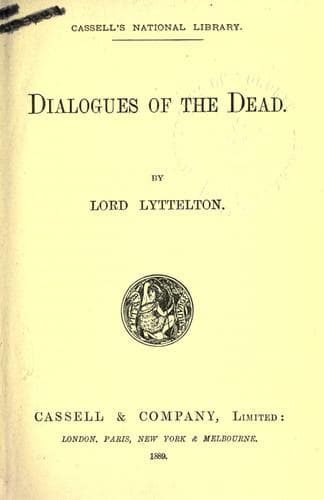
Dialogues of the DeadLyttelton, George Lyttelton, Baron
Philosophy
Dialogues of the Dead
Lyttelton, George Lyttelton, Baron
Dialogues, English -- Early works to 1800; Imaginary conversations
_Boileau_.--France, too, has produced some very excellent writers since
the time of my death. Of one particularly I hear wonders. Fame to him
is as kind as if he had been dead a thousand years. She brings his
praises to me from all parts of Europe. You know I speak of Voltaire.
_Pope_.--I do; the English nation yields to none in admiration of his
extensive genius. Other writers excel in some one particular branch of
wit or science; but when the King of Prussia drew Voltaire from Paris to
Berlin, he had a whole academy of _belles lettres_ in him alone.
_Boileau_.--That prince himself has such talents for poetry as no other
monarch in any age or country has ever possessed. What an astonishing
compass must there be in his mind, what an heroic tranquillity and
firmness in his heart, that he can, in the evening, compose an ode or
epistle in the most elegant verse, and the next morning fight a battle
with the conduct of Caesar or Gustavus Adolphus!
_Pope_.--I envy Voltaire so noble a subject both for his verse and his
prose. But if that prince will write his own commentaries, he will want
no historian. I hope that, in writing them, he will not restrain his
pen, as Caesar has done, to a mere account of his wars, but let us see
the politician, and the benignant protector of arts and sciences, as well
as the warrior, in that picture of himself. Voltaire has shown us that
the events of battles and sieges are not the most interesting parts of
good history, but that all the improvements and embellishments of human
society ought to be carefully and particularly recorded there.
_Boileau_.--The progress of arts and knowledge, and the great changes
that have happened in the manners of mankind, are objects far more worthy
of a leader's attention than the revolutions of fortune. And it is
chiefly to Voltaire that we owe this instructive species of history.
_Pope_.--He has not only been the father of it among the moderns, but has
carried it himself to its utmost perfection.
_Boileau_.--Is he not too universal? Can any writer be exact who is so
comprehensive?
_Pope_.--A traveller round the world cannot inspect every region with
such an accurate care as exactly to describe each single part. If the
outlines are well marked, and the observations on the principal points
are judicious, it is all that can be required.
_Boileau_.--I would, however, advise and exhort the French and English
youth to take a fuller survey of some particular provinces, and to
remember that although, in travels of this sort, a lively imagination is
a very agreeable companion, it is not the best guide. To speak without a
metaphor, the study of history, both sacred and profane, requires a
critical and laborious investigation. The composer of a set of lively
and witty remarks on facts ill-examined, or incorrectly delivered, is not
an historian.
_Pope_.--We cannot, I think, deny that name to the author of the "Life of
Charles XII., King of Sweden."
Public-domain text, read in full here on John Shaqi.
Reviews
Reviews
No reviews yet
Be the first to share your thoughts on this work.
Elsewhere in the archive
Join the Discussion
Join the discussion
Sign in to leave a comment or review.
Sign InorCreate an account