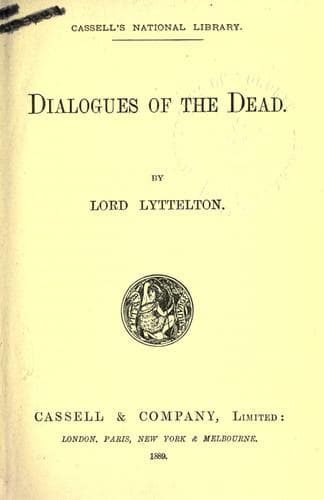
Dialogues of the DeadLyttelton, George Lyttelton, Baron
Philosophy
Dialogues of the Dead
Lyttelton, George Lyttelton, Baron
Dialogues, English -- Early works to 1800; Imaginary conversations
house; I persisted to take care of his children by Fulvia, the same
tender care as of my own. I gave my protection to all his friends at
Rome. I implored my brother not to make my jealousy or my wrongs the
cause of a civil war. But the injuries done to Rome by Antony's conduct
could not possibly be forgiven. When he found he should draw the Roman
arms on himself, he sent orders to me to leave his house. I did so, but
carried with me all his children by Fulvia, except Antyllus, the eldest,
who was then with him in Egypt. After his death and Cleopatra's, I took
her children by him, and bred them up with my own.
_Arria_.--Is it possible, madam? the children of Cleopatra?
_Octavia_.--Yes, the children of my rival. I married her daughter to
Juba, King of Mauritania, the most accomplished and the handsomest prince
in the world.
_Arria_.--Tell me, Octavia, did not your pride and resentment entirely
cure you of your passion for Antony, as soon as you saw him go back to
Cleopatra? And was not your whole conduct afterwards the effect of cool
reason, undisturbed by the agitations of jealous and tortured love?
_Octavia_.--You probe my heart very deeply. That I had some help from
resentment and the natural pride of my sex, I will not deny. But I was
not become indifferent to my husband. I loved the Antony who had been my
lover, more than I was angry with the Antony who forsook me and loved
another woman. Had he left Cleopatra and returned to me again with all
his former affection, I really believe I should have loved him as well as
before.
_Arria_.--If the merit of a wife is to be measured by her sufferings,
your heart was unquestionably the most perfect model of conjugal virtue.
The wound I gave mine was but a scratch in comparison to many you felt.
Yet I don't know whether it would be any benefit to the world that there
should be in it many Octavias. Too good subjects are apt to make bad
kings.
_Portia_.--True, Arria; the wives of Brutus and Cecinna Paetus may be
allowed to have spirits a little rebellious. Octavia was educated in the
Court of her brother. Subjection and patience were much better taught
there than in our houses, where the Roman liberty made its last abode.
And though I will not dispute the judgment of Minos, I can't help
thinking that the affection of a wife to her husband is more or less
respectable in proportion to the character of that husband. If I could
have had for Antony the same friendship as I had for Brutus, I should
have despised myself.
_Octavia_.--My fondness for Antony was ill-placed; but my perseverance in
the performance of all the duties of a wife, notwithstanding his
ill-usage, a perseverance made more difficult by the very excess of my
love, appeared to Minos the highest and most meritorious effort of female
resolution against the seductions of the most dangerous enemy to our
virtue, offended pride.
DIALOGUE XVI.
Public-domain text, read in full here on John Shaqi.
Reviews
Reviews
No reviews yet
Be the first to share your thoughts on this work.
Elsewhere in the archive
Join the Discussion
Join the discussion
Sign in to leave a comment or review.
Sign InorCreate an account