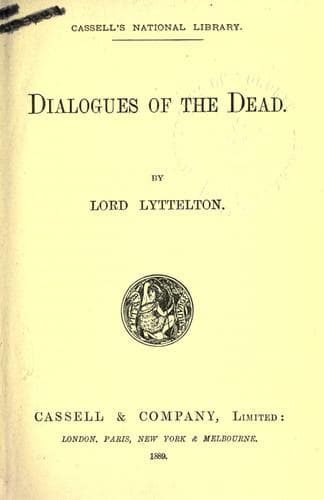
Dialogues of the DeadLyttelton, George Lyttelton, Baron
Philosophy
Dialogues of the Dead
Lyttelton, George Lyttelton, Baron
Dialogues, English -- Early works to 1800; Imaginary conversations
there was no reason to fear any violence or maladministration in Italy or
in Rome. Cicero would have had the chief authority in the Senate. The
praetorship of the city had been conferred upon you by the favour of
Caesar, and your known credit with him, added to the high reputation of
your virtues and abilities, gave you a weight in all business which none
of his party left behind him in Italy would have been able to oppose.
What a fair prospect was here of good order, peace, and liberty at home,
while abroad the Roman name would have been rendered more glorious, the
disgrace of Crassus revenged, and the Empire extended beyond the utmost
ambition of our forefathers by the greatest general that ever led the
armies of Rome, or, perhaps, of any other nation! What did it signify
whether in Asia, and among the barbarians, that general bore the name of
King or Dictator? Nothing could be more puerile in you and your friends
than to start so much at the proposition of his taking that name in Italy
itself, when you had suffered him to enjoy all the power of royalty, and
much more than any King of Rome had possessed from Romulus down to
Tarquin.
_Brutus_.--We considered that name as the last insult offered to our
liberty and our laws; it was an ensign of tyranny, hung out with a vain
and arrogant purpose of rendering the servitude of Rome more apparent.
We, therefore, determined to punish the tyrant, and restore our country
to freedom.
_Atticus_.--You punished the tyrant, but you did not restore your country
to freedom. By sparing Antony, against the opinion of Cassius, you
suffered the tyranny to remain. He was Consul, and, from the moment that
Caesar was dead, the chief power of the State was in his hands. The
soldiers adored him for his liberality, valour, and military frankness.
His eloquence was more persuasive from appearing unstudied. The nobility
of his house, which descended from Hercules, would naturally inflame his
heart with ambition. The whole course of his life had evidently shown
that his thoughts were high and aspiring, and that he had little respect
for the liberty of his country. He had been the second man in Caesar's
party; by saving him you gave a new head to that party, which could no
longer subsist without your ruin. Many who would have wished the
restoration of liberty, if Caesar had died a natural death, were so
incensed at his murder that, merely for the sake of punishing that, they
were willing to confer all power upon Antony and make him absolute master
of the Republic. This was particularly true with respect to the veterans
who had served under Caesar, and he saw it so plainly that he presently
availed himself of their dispositions. You and Cassius were obliged to
fly out of Italy, and Cicero, who was unwilling to take the same part,
could find no expedient to save himself and the Senate but the wretched
one of supporting and raising very high another Caesar, the adopted son
Public-domain text, read in full here on John Shaqi.
Reviews
Reviews
No reviews yet
Be the first to share your thoughts on this work.
Elsewhere in the archive
Join the Discussion
Join the discussion
Sign in to leave a comment or review.
Sign InorCreate an account