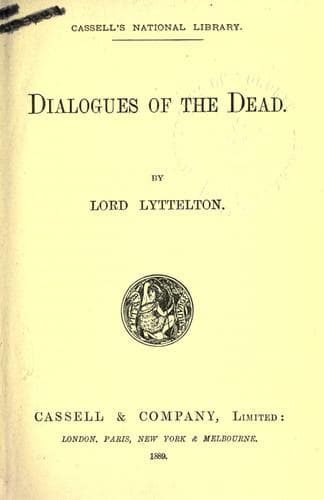
Dialogues of the DeadLyttelton, George Lyttelton, Baron
Philosophy
Dialogues of the Dead
Lyttelton, George Lyttelton, Baron
Dialogues, English -- Early works to 1800; Imaginary conversations
_De Witt_.--I am ashamed of my error; but the chief cause of it was that,
though I thought very ill, I did not think quite so ill of Charles II.
and his Ministry as they deserved. I imagined, too, that his Parliament
would restrain him from engaging in such a war, or compel him to engage
in our defence if France should attack us. These, I acknowledge, are
excuses, not justifications. When the French marched into Holland and
found it in a condition so unable to resist them, my fame as a Minister
irrecoverably sank; for, not to appear a traitor, I was obliged to
confess myself a dupe. But what praise is sufficient for the wisdom and
virtue you showed in so firmly rejecting the offers which, I have been
informed, were made to you, both by England and France, when first you
appeared in arms at the head of your country, to give you the sovereignty
of the Seven Provinces by the assistance and under the protection of the
two Crowns! Believe me, great prince, had I been living in those times,
and had known the generous answers you made to those offers (which were
repeated more than once during the course of the war), not the most
ancient and devoted servant to your family would have been more your
friend than I. But who could reasonably hope for such moderation, and
such a right sense of glory, in the mind of a young man descended from
kings, whose mother was daughter to Charles I., and whose father had left
him the seducing example of a very different conduct? Happy, indeed, was
the English nation to have such a prince, so nearly allied to their Crown
both in blood and by marriage, whom they might call to be their deliverer
when bigotry and despotism, the two greatest enemies to human society,
had almost overthrown their whole constitution in Church and State!
_William_.--They might have been happy, but were not. As soon as I had
accomplished their deliverance for them, many of them became my most
implacable enemies, and even wished to restore the unforgiving prince
whom they had so unanimously and so justly expelled from his kingdom.
Such levity seems incredible. I could not myself have imagined it
possible, in a nation famed for good sense, if I had not had proofs of it
beyond contradiction. They seemed as much to forget what they called me
over for as that they had called me over. The security of their
religion, the maintenance of their liberty, were no longer their care.
All was to yield to the incomprehensible doctrine of right divine and
passive obedience. Thus the Tories grew Jacobites, after having
renounced both that doctrine and King James, by their opposition to him,
by their invitation of me, and by every Act of the Parliament which gave
me the Crown. But the most troublesome of my enemies were a set of
Republicans, who violently opposed all my measures, and joined with the
Jacobites in disturbing my government, only because it was not a
commonwealth.
Public-domain text, read in full here on John Shaqi.
Reviews
Reviews
No reviews yet
Be the first to share your thoughts on this work.
Elsewhere in the archive
Join the Discussion
Join the discussion
Sign in to leave a comment or review.
Sign InorCreate an account