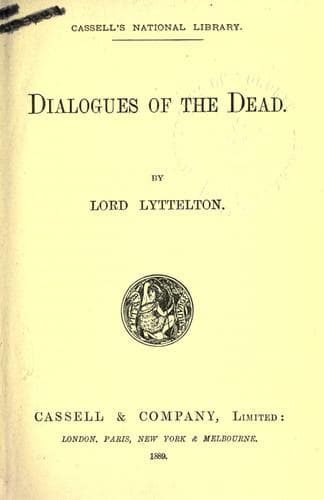
Dialogues of the DeadLyttelton, George Lyttelton, Baron
Philosophy
Dialogues of the Dead
Lyttelton, George Lyttelton, Baron
Dialogues, English -- Early works to 1800; Imaginary conversations
_William_.--There were, I must acknowledge, some faults in my temper and
some in my government, which are an excuse for my subjects with regard to
the uneasiness and disquiet they gave me. My taciturnity, which suited
the genius of the Dutch, offended theirs. They love an affable prince;
it was chiefly his affability that made them so fond of Charles II. Their
frankness and good-humour could not brook the reserve and coldness of my
nature. Then the excess of my favour to some of the Dutch, whom I had
brought over with me, excited a national jealousy in the English and hurt
their pride. My government also appeared, at last, too unsteady, too
fluctuating between the Whigs and the Tories, which almost deprived me of
the confidence and affection of both parties. I trusted too much to the
integrity and the purity of my intentions, without using those arts that
are necessary to allay the ferment of factions and allure men to their
duty by soothing their passions. Upon the whole I am sensible that I
better understood how to govern the Dutch than the English or the Scotch,
and should probably have been thought a greater man if I had not been
King of Great Britain.
_De Witt_.--It is a shame to the English that gratitude and affection for
such merit as yours were not able to overcome any little disgusts arising
from your temper, and enthrone their deliverer in the hearts of his
people. But will your Majesty give me leave to ask you one question? Is
it true, as I have heard, that many of them disliked your alliances on
the Continent and spoke of your war with France as a Dutch measure, in
which you sacrificed England to Holland?
_William_.--The cry of the nation at first was strong for the war, but
before the end of it the Tories began publicly to talk the language you
mention. And no wonder they did, for, as they then had a desire to set
up again the maxims of government which had prevailed in the reign of
their beloved Charles II., they could not but represent opposition to
France, and vigorous measures taken to restrain her ambition, as
unnecessary for England, because they well knew that the counsels of that
king had been utterly averse to such measures; that his whole policy made
him a friend to France; that he was governed by a French mistress, and
even bribed by French money to give that Court his assistance, or at
least his acquiescence, in all their designs.
Public-domain text, read in full here on John Shaqi.
Reviews
Reviews
No reviews yet
Be the first to share your thoughts on this work.
Elsewhere in the archive
Join the Discussion
Join the discussion
Sign in to leave a comment or review.
Sign InorCreate an account