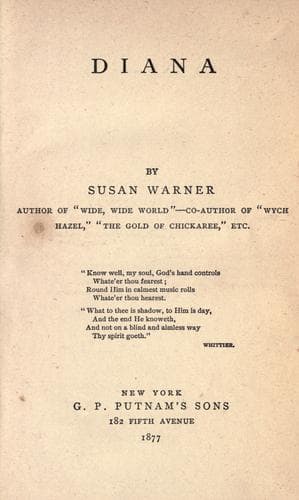
New England -- Social life and customs -- 19th century -- Fiction; Women -- New England -- Fiction
Diana would have written to Mr. Knowlton to get her mystery solved; she
was far too simple and true to stand upon needless punctilio; but she
did not know how to address to him a letter. Evan himself had not known
when he parted from her; the information came in that epistle that
never reached her hands, that first letter. Names and directions had
all perished in the flames, and for want of them Diana could do
nothing. Meanwhile, what would Evan think? He would expect an answer,
and a quick answer, to his letter; he was looking for it now, no doubt;
wondering why it did not come, and disappointed, and fearing something
wrong. That trouble, of fearing something wrong, Diana was spared; for
she knew the family at Elmfield had heard, and all was well; but
sometimes her other troublesome thoughts made her powerless hands come
together with a clasp of wild pain. How long must she wait now? how
long would Evan wait, before in desperation he wrote again? And where
was her letter? for it had been written and sent; that she knew;--was
it lost? was it stolen? Had somebody's curiosity prevailed so far, and
was her precious secret town property by this time? Every day became
harder to bear; every week made the suspense more intolerable. Mrs.
Starling was far out in one of her suppositions. Will Flandin came a
good deal about the house, it is true; but Diana hardly knew he was
there. If she thought about it at all, she was half glad, because his
presence might serve to mask her silence and abstraction. She was
conscious of both, and the effort to cover the one and hide the other
was very painful sometimes.
October glories were passed away, and November days grew shorter and
shorter, colder and more dreary. It seemed now and then to Diana that
summer had gone to a distance from which it would never revisit her.
And after those days of constant communication with Evan, the blank
cessation of it, the ignorance of all that had befallen or was
befalling him, the want of a word of remembrance or affection, grew
almost to a blank of despair.
It was late in the month.
"What waggon's that stopping?" exclaimed Mrs. Starling one afternoon.
Mother and daughter were in the lean-to. Diana looked out, and saw with
a pang of various feelings what waggon it was.
"Ain't that the Elmfield folks?"
"I think so."
"I know so. I thought Mrs. Reverdy and the rest had run away from the
cold."
"Didn't you know Miss Masters had been sick?"
"How should I know it?"
"I heard so. I didn't know but you had heard it."
"I can't hear things without somebody tells me. Go along up-stairs,
Diana, and put on something."
Public-domain text, read in full here on John Shaqi.
Reviews
Reviews
No reviews yet
Be the first to share your thoughts on this work.
Elsewhere in the archive
Join the Discussion
Join the discussion
Sign in to leave a comment or review.
Sign InorCreate an account