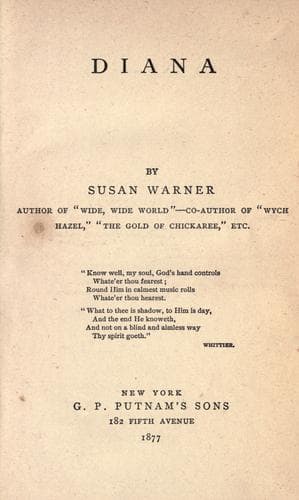
New England -- Social life and customs -- 19th century -- Fiction; Women -- New England -- Fiction
She went in slowly, went to the window, opened it and sat down before
it. June had come again; one day of June was passed, and to-morrow
would be the second. Through the bustle of May, Diana had hardly given
a look to the weather or a thought to the time of year; it greeted her
now at her window like a dear old friend that she had been forgetting.
The moon, about an hour high, gave a gentle illumination through the
dewy air, revealing plainly enough the level meadows, and the hills
which made their distant bordering. The scent of roses and honeysuckles
was abroad; just under Diana's window there was a honeysuckle vine in
full blossom, and the rich, peculiar fragrance came in heavily-laden
puffs of air; the softest of breezes brought them, stirring the little
leaves lazily, and just touched Diana's face, sweet and tender,
reminding, caressing. Reminding of what? For it began to stir vaguely
and uneasily in Diana's heart. Things not thought of before put in a
claim to be looked at. This her home and sanctuary for so many years,
it was to be hers no longer. This was the last night at her window, by
her honeysuckle vine. She would not have another evening the enjoyment
of her wonted favourite view over the fields and hills; she had done
with all that. Other scenes, another home, would claim her; and then
slowly rose the thought that her freedom was gone; this was the last
time she would belong to herself. Oddly enough, nothing of all this had
come under consideration before. Diana had been stunned; she had
believed for a long time that she was dead, mentally; she had been, as
it were, in a slumber, partly of hopelessness, partly of preoccupation;
now the time of waking had come; and the hidden life in her stirred and
rose and shivered with the consciousness that it _was_ alive and in its
full strength, and what it meant for it to be alive now. As I said,
Diana's nature was too sound and well-balanced and strong for anything
to crush it, or even any part of it; and now she knew that the nerves
of feeling she thought Evan had killed for ever, were all astir and
quivering, and would never be fooled into slumbering again. I cannot
tell how all this dawned and broke to her consciousness. She had sat
down at her window a calm, weary-hearted girl, placid, and with even a
dull sort of content upon her; so she had sat and dreamed awhile; and
then June and moonlight, and her honeysuckle, and the roses, and the
memory of her free childish days, and the image of her lost lover, and
the thought of where she was standing, by degrees--how gently they did
it, too--roused her and pricked her up to the consciousness of what she
going to do. What was she going to do? Marry a man who had no real
place in her heart. She had thought it did not matter; she had thought
she was dead; now all at once she knew that she was alive in every
fibre, and that it mattered fearfully. The idea of Mr. Masters stung
her, not as novel-writers say "almost to madness,"--for there was no
Public-domain text, read in full here on John Shaqi.
Reviews
Reviews
No reviews yet
Be the first to share your thoughts on this work.
Elsewhere in the archive
Join the Discussion
Join the discussion
Sign in to leave a comment or review.
Sign InorCreate an account