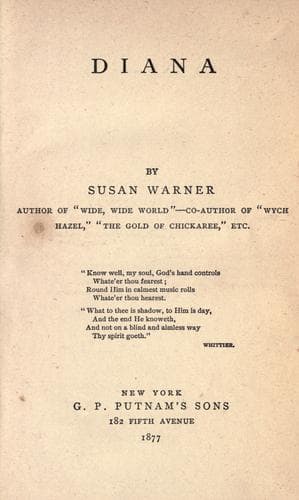
New England -- Social life and customs -- 19th century -- Fiction; Women -- New England -- Fiction
sat, it might have been a duchess, for the beautiful unconscious ease
with which she did it. Nature's high breeding; there is such a thing,
and there is such an effect of it when the constitution of mind and
body are alike noble.
Basil poured out her cup of tea, and divided her quail, and then sat
down. It was hard for her to bear.
"You are too good to me," said Diana humbly.
"I should like to see you prove that."
"I am not sure but you are too good to everybody."
"Why? how can one be too good?"
"You won't get paid for it."
"I think I shall," said Basil, in a quiet confident way he had, which
was provoking if you were arguing with him. But Diana was not arguing
with him.
"Basil, _I_ can never pay you," she said, with a voice that faltered a
little.
"You are sure of that in your own mind?"
"Very sure!"
"I am a man of a hopeful turn of nature. Shall I divide that joint for
you?"
"My hands cannot manage a quail!" said Diana, yielding her knife and
fork to him. "What can make me so weak?"
"You have had fever."
"But I have no fever now, and I do not seem to get my strength back."
"After the unnatural tension, Nature takes her revenge."
"It is very hard on you!"
"What?"
Diana did not answer. She had spoken that last word with almost a break
in her voice; she gave her attention now diligently to picking the
quail bones. But when her supper was done, and the tray delivered over
to Miss Collins, Basil did not, as sometimes he did, go away and leave
her, but sat down again and trimmed the fire. Diana lay back in her
chair, looking at him.
"Basil," she said at last after a long silence,--"do you think
mistakes, I mean life-mistakes, can ever be mended in this world?"
"You must define what you mean by mistakes," he said without looking at
her. "There are no _mistakes_, love, but those which we make by our own
fault."
"O but yes there are, Basil!"
"Not what _I_ mean by mistakes."
"Then what do you call them? When people's lives are all spoiled by
something they have had nothing to do with--by death, or sickness, or
accident, or misfortune."
"I call it," said Basil slowly, and still without looking at her,--"I
call it, when it touches me or you, or other of the Lord's
children,--God's good hand."
"O no, Basil! people's wickedness cannot be his hand."
"People's wickedness is their own. And other evil I believe is wrought
by the prince of this world. But God will use people's wickedness, and
even Satan's mischief, to his children's best good; and so it becomes,
in so far, his blessed hand. Don't you know he has promised, 'There
shall no evil happen to the just'? And that 'all things shall work
together for good to them that love God?' His promise does not fail, my
child."
"But, Basil,--loads of things do happen to them which _cannot_ work for
their good."
"Then what becomes of the Lord's promise?"
"He cannot have made it, I think."
"He has made it, and you and I believe it."
Public-domain text, read in full here on John Shaqi.
Reviews
Reviews
No reviews yet
Be the first to share your thoughts on this work.
Elsewhere in the archive
Join the Discussion
Join the discussion
Sign in to leave a comment or review.
Sign InorCreate an account