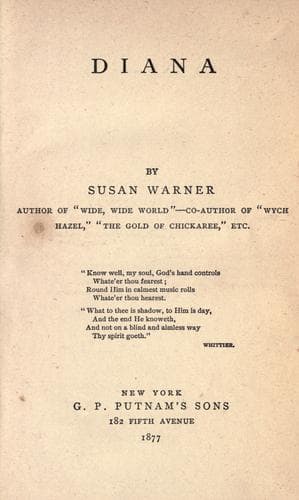
New England -- Social life and customs -- 19th century -- Fiction; Women -- New England -- Fiction
It was the end of September. Nearing a time of storms again in the air
and on the sea; but an absolute calm had settled down upon Diana. Not
at all the calm of death; for after death, in this warfare, comes not
only victory, but new life. It was very strange, even to herself. She
had ceased to think of Captain Knowlton; if she thought of him, it was
with the recognition that his power over her was gone. She felt like a
person delivered from helpless bondage. There was some lameness, there
were some bruises yet from the fight gone by; but Diana was every day
recovering from these, and elasticity and warmth were coming back to
the members that had been but lately rigid and cold. The sun shone
again for her, and the sky was blue, and the arch of it grew every day
loftier and brighter to her sense. At first coming to Clifton, Diana
had perceived the beauties and novelties of her new surroundings; now
she began to enjoy them. The salt air was delicious; the light morning
mist over the bay, as she saw it when she went to take her morning
bath, held a whole day of sunlit promise within its mysterious folds;
the soft low hum of the distant city, which she could hear when the
waves were still, made the solitude and the freshness and the purity of
the island seem doubly rare and sweet. And her baby began to be now to
Diana the most wonderful of delights; more than ever it had been at any
previous time.
All this while she had had letters from Basil; not very long letters,
such as a man can write to a woman whose whole sympathy he knows he
has; but good letters, such as a man can write to a woman to whom his
own heart and soul have given all they have. Not that he ever spoke of
that fact, or alluded to it. Basil was no maudlin, and no fool to ask
for a gift which cannot be yielded by an effort of will; and besides,
he had never entirely lost hope; so that, though things were dark
enough for him certainly, he could write manly, strong, sensible
letters, which, in their very lack of all allusion to his own feelings,
spoke whole volumes to the woman who knew him and could interpret them.
The thought of him grieved her; it was getting to be now the only grief
she had. Her own letters to him were brief and rare. Diana had a
nervous fear of letting the Clifton postmark be seen on a letter of
hers at home, knowing what sort of play sometimes went on in the
Pleasant Valley post office; so she never sent a letter except when she
had a chance to despatch it from New York. These epistles were very
abstract; they spoke of the baby, told of Mrs. Sutphen, gave details of
things seen and experienced; but of Diana's inner life, the fight and
the victory, not a whit. She could not write about them to Basil; for,
glad as he would be of what she could tell him, she could not say
enough. In getting deliverance from a love it was wrong to indulge, in
becoming able to forget Evan, she had not thereby come nearer to her
Public-domain text, read in full here on John Shaqi.
Reviews
Reviews
No reviews yet
Be the first to share your thoughts on this work.
Elsewhere in the archive
Join the Discussion
Join the discussion
Sign in to leave a comment or review.
Sign InorCreate an account