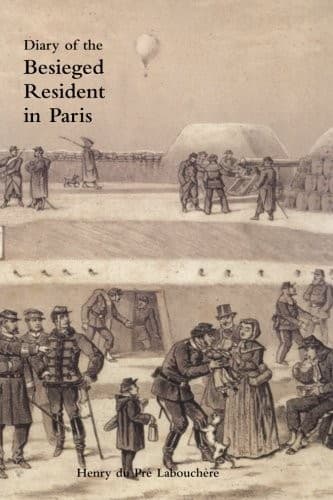
Diary of the Besieged Resident in ParisLabouchere, Henry Du Pré
History
Diary of the Besieged Resident in Paris
Labouchere, Henry Du Pré
Franco-Prussian War, 1870-1871; Paris (France) -- History -- Siege, 1870-1871 -- Personal narratives
that there were any there. Several officers with whom I spoke said that
it was very doubtful. On my return, my cabman, who had got over his
liquor, wanted double his fare. "For myself," he said, "I am a
Frenchman, and I should scorn to ask for money for running a risk of
being shot by a _canaille_ of a German, but think of my horse;" and then
he patted the faithful steed, whom I may possibly have the pleasure to
meet again, served up in a sauce piquante. The newspapers, almost
without exception, protest against the mediation of England and Russia,
which they imagine is offered by these Powers. "It is too late," says
the organ of M. Picard. "Can France accept a mediation which will snatch
from her the enemy at the moment when victory is certain?"
_October 25th._
Has General Trochu a plan?--if so, what is it? It appears to me, as Sir
Robert Peel would have said, that he has only three courses to pursue:
first, to do nothing, and to capitulate as soon as he is starved out;
this would, I reckon, bring the siege to an end in about two months:
secondly, to fight a battle with all his disposable forces, which might
be prolonged for several days, and thus risk all upon one great venture:
thirdly, to cut his way out of Paris with the line and the Mobiles. The
two united would form a force of about 150,000 men, and supported by 500
cannon, it may reasonably be expected that the Prussian lines would be
pierced. In this case a junction might be effected with any army which
exists in the provinces, and the combined force might throw itself upon
the enemy's line of communications. In the meantime Paris would be
defended by its forts and its ramparts. The former would be held by the
sailors and the mobilized National Guards of Paris, the latter by the
Sedentary Garde Nationale. Which of these courses will be adopted, it is
impossible to say; the latter, however, is the only one which seems to
present even a chance of ultimate success. With respect to the second, I
do not think that the Mobiles could stand for days or even for hours
against the artillery and musketry force of their opponents. They are
individually brave, but like all raw troops they become excited under
fire, shoot wildly, then rush forward in order to engage in a
hand-to-hand encounter, and break before they reach the Prussian lines.
In this respect the troops of the line are not much better. The
Prussian tactics, indeed, have revolutionized the whole system of
warfare, and the French, until they have learnt them, will always go to
the wall.
Public-domain text, read in full here on John Shaqi.
Reviews
Reviews
No reviews yet
Be the first to share your thoughts on this work.
Elsewhere in the archive
Join the Discussion
Join the discussion
Sign in to leave a comment or review.
Sign InorCreate an account