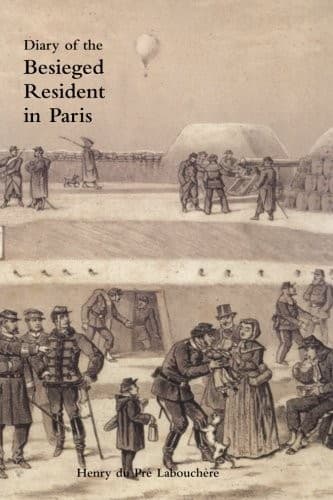
Diary of the Besieged Resident in ParisLabouchere, Henry Du Pré
History
Diary of the Besieged Resident in Paris
Labouchere, Henry Du Pré
Franco-Prussian War, 1870-1871; Paris (France) -- History -- Siege, 1870-1871 -- Personal narratives
Yesterday evening until eleven o'clock--a late hour now for Paris;--the
Boulevards were crowded. Although the news that Bourget had been retaken
by the Prussians had been _affiche_ at the Mairies, those who asserted
it were at first treated as friends of Prussia. Little by little the
fact was admitted, and then, every one fell to denouncing the
Government. To-day the official bulletin states that we retreated in
good order, leaving "some" prisoners. From what I hear from officers who
were engaged, the Mobiles fought well for some time, although their
ammunition was so wet that they could only fire twelve shots with their
cannon, and not one with their mitrailleuse. When they saw that they
were likely to be surrounded, there was a stampede to Aubervilliers and
to Drancy, the latter of which was subsequently evacuated. To-day we
have two pieces of news--that M. Thiers entered Paris yesterday, and
that Metz has fallen. The _Journal des Debats_ also publishes copious
extracts from a file of provincial papers up to the 26th, which it has
obtained.
I hear that M. Thiers advises peace on any terms. The Government of
Paris is in a difficult position. It has followed in the course of
Palikao. By a long _suggestio falsi et suppressio veri_ it has led the
population of this city to believe that the position of France has
bettered itself every day that the siege has lasted. We have been told
that Bazaine could hold out indefinitely, that vast armies were forming
in the provinces, and would, before the middle of November, march to the
relief of Paris; that the investing army was starving, and that it had
been unable to place a single gun in position within the range of the
forts; that we had ample provisions until the month of February, and
that there would not be the slightest difficulty in introducing convoys.
Anyone who ventured to question these facts was held up to public
execration. General Trochu announced that he had a "plan," and that if
only he were left to carry it out, it must result in success. All this
time the General and the members of the Government, who were at
loggerheads with each other, privately confessed to their friends that
the situation was growing every day more critical.
Public-domain text, read in full here on John Shaqi.
Reviews
Reviews
No reviews yet
Be the first to share your thoughts on this work.
Elsewhere in the archive
Join the Discussion
Join the discussion
Sign in to leave a comment or review.
Sign InorCreate an account