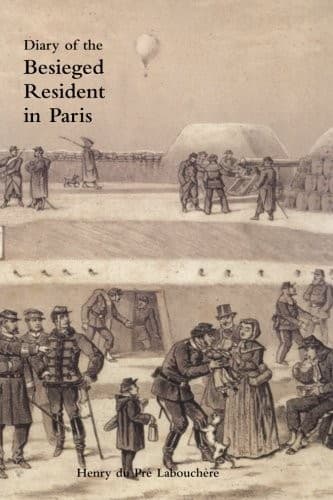
Diary of the Besieged Resident in ParisLabouchere, Henry Du Pré
History
Diary of the Besieged Resident in Paris
Labouchere, Henry Du Pré
Franco-Prussian War, 1870-1871; Paris (France) -- History -- Siege, 1870-1871 -- Personal narratives
The Ultras bitterly complain that the members of the Government agreed
to the election of a Commune, on the recommendation of all the mayors,
and that now they are going back from their concession, and are
following in the steps of the Empire and taking refuge in a Plebiscite.
They, therefore, recommend their friends to abstain from voting. The
fact is, that the real question at issue is, whether Paris is to resist
to the end, or whether it is to fall back from the determination to do
so, which it so boldly and so vauntingly proclaimed. The bourgeois are
getting tired of marching to the ramparts, and making no money; the
working-men are thoroughly enjoying themselves, and are perfectly ready
to continue the _status quo_. I confess I rather sympathise with the
latter. They may not be over wise, but still it seems to me that Paris
ought to hold out as long as bread lasts, without counting the cost. She
had invited the world to witness her heroism, and now she endeavours to
back out of the position which she has assumed. I have not been down to
Belleville to-day, but I hear that there and in the other outer
Faubourgs there is great excitement, and the question of a rising is
being discussed. Flourens and some other commanders of battalions have
been cashiered, but they are still in command, and no attempt is being
made to oblige them to recognise the decree. Rochefort has resigned his
seat in the Government, on the ground that he consented to the election
of the Commune. The general feeling among the shopkeepers seems to be to
accept an armistice on almost any terms, because they hope that it will
lead to peace. We will take our revenge, they say, in two years. A
threat which simply means that if the French army can fight then, they
will again shout "_a Berlin_!" M. Thiers is still at Versailles. There
appears to be a tacit truce, but none knows precisely what is going on.
A friend of mine saw General Trochu yesterday on business, and he tells
me that this worthy man was then so utterly prostrated, that he did not
even refer to the business which he had come to transact. Never was a
man more unfit to defend a great capital. "Why do you not act with
energy against the Ultras?" said my friend. "I wish," replied Trochu,
"to preserve my power by moral force." This is all very well, but can
the commander of a besieged town be said to have preserved his power
when he allows himself to be imprisoned by a mob for six hours, and then
does not venture to punish its leaders? Professor Fustel de Coulanges
has written a reply to Professor Mommsen. He states the case of France
with respect to Alsace very clearly. "Let Prussia double the war-tax she
imposes on France, and give up this iniquitous scheme of annexation,"
ought to be the advice of every sincere friend of peace. In any case, if
Alsace and Lorraine are turned with the German Rhine Provinces into a
neutral State, I do hope that we shall have the common sense not to
Public-domain text, read in full here on John Shaqi.
Reviews
Reviews
No reviews yet
Be the first to share your thoughts on this work.
Elsewhere in the archive
Join the Discussion
Join the discussion
Sign in to leave a comment or review.
Sign InorCreate an account