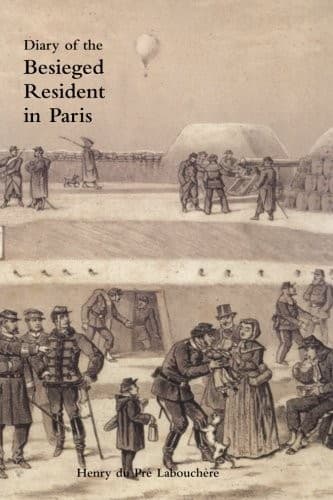
Diary of the Besieged Resident in ParisLabouchere, Henry Du Pré
History
Diary of the Besieged Resident in Paris
Labouchere, Henry Du Pré
Franco-Prussian War, 1870-1871; Paris (France) -- History -- Siege, 1870-1871 -- Personal narratives
I see in an English paper of the 3rd that it is believed at Versailles
that we have only fresh meat for twelve days. We are not so badly off as
that. How many oxen and cows there still are I do not know; a few days
ago, however, I counted myself 1,500 in a large pen. The newspapers
calculate that at the commencement of the siege there were 100,000
horses in Paris, and that there are now 70,000; 30,000 will be enough
for the army, consequently 40,000 can be eaten. The amount of meat on
each horse averages 500 lb., consequently we have twenty million pounds
of fresh horse-flesh, a quantity which will last us for more than three
months at the present rate of the meat consumption. These figures are, I
think, very much exaggerated. I should say that there are not more than
40,000 horses now in Paris. The _Petites Voitures_ (Cab) Company has
8,000, and offered to sell them to the Government a few days ago, but
that proposal was declined. As regards salt meat, the Government keep
secret the amount. It cannot, however, be very great, because it is only
derived from animals which have been killed since the siege commenced.
The stock of flour, we are told, is practically unlimited, and as no
attempt is made to prevent its waste in pasty and fancy cakes, the
authorities are acting apparently on this assumption.
The health of Paris is far from satisfactory, and when the winter
weather regularly sets in there will be much sickness. No one is
absolutely starving, but many are without sufficient nourishment. The
Government gives orders for 10c. worth of bread to all who are in want,
and these orders are accepted as money by all the bakers. In each
arrondissement there are also what are called cantines economiques,
where a mess of soup made from vegetables and a small quantity of meat
can be bought for five centimes. Very little, however, has been done to
distribute warm clothing among the poor, and when it is considered that
above 100,000 persons have come into Paris from the neighbouring
villages, most of whom are dependent upon public or private charity, it
is evident that, even if there is no absolute want, there must be much
suffering. Count Bismarck was not far wrong when he said that, if the
siege be prolonged until our stock of provisions is exhausted, many
thousands in the succeeding weeks will die of starvation. I would
recommend those charitable persons who are anxious to come to the aid of
this unfortunate country to be ready to throw provisions into Paris as
soon as communications with England are reopened, rather than to
subscribe their money to ambulances. All things considered, the wounded
are well tended. In the hotel in which I am residing the Societe
Internationale has established its headquarters. We have now 160 wounded
here, and beds are prepared for 400. The ambulance occupies two stories,
for which 500 francs a day are paid; and an arrangement has been made
with the administration of the hotel to feed each convalescent for 2.50
Public-domain text, read in full here on John Shaqi.
Reviews
Reviews
No reviews yet
Be the first to share your thoughts on this work.
Elsewhere in the archive
Join the Discussion
Join the discussion
Sign in to leave a comment or review.
Sign InorCreate an account