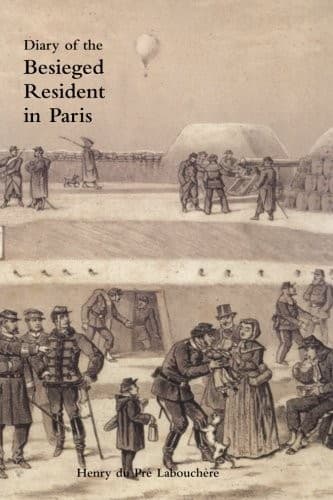
Diary of the Besieged Resident in ParisLabouchere, Henry Du Pré
History
Diary of the Besieged Resident in Paris
Labouchere, Henry Du Pré
Franco-Prussian War, 1870-1871; Paris (France) -- History -- Siege, 1870-1871 -- Personal narratives
If sieges were likely to occur frequently, the whole system of
ambulances, as against military hospitals, would have to be ventilated.
There are in Paris two hundred and forty-three ambulances, and when the
siege commenced, such was the anxiety to obtain a _blesse_, that when a
sortie took place, those who brought them in were offered bribes to take
them to some house over which the flag of Geneva waved. A man with a
broken leg or arm was worth thirty francs to his kind preservers. The
largest ambulance is the International. Its headquarters are at the
Grand Hotel. It seems to me over-manned, for the number of the healthy
who receive pay and rations from its funds exceeds the number of the
wounded. Many, too, of the former are young unmarried men, who ought to
be serving either in the ranks of the army, or at least of the Garde
Nationale. The following story I take from an organ of public opinion of
to-day's date:--A lady went to her Mairie to ask to be given a wounded
soldier to look after. She was offered a swarthy Zouave. "No," she said,
"I wish for a blonde, being a brunette myself"--nothing like a
contrast.
CHAPTER XII.
_November 29th._
From morning to evening cannon were rolling and troops were marching
through the streets. Since Saturday night the gates of the town had been
rigidly closed to all civilians, and even those provided with passes
from headquarters were refused egress. It was known that the grand
effort which is to make or mar us was to be made the next morning, and
it was hoped that the Prussians would be taken unawares. The plan, in
its main details, was confided to me by half a dozen persons, and,
therefore, I very much question whether it is a secret to the enemy.
Most of those who take an interest in the war have, I presume, a map of
Paris. If they consult it, they will see that the Marne from the east,
and the Seine from the south, unite about a mile from the south-eastern
corner of the enceinte. Two miles before the junction of the two rivers
the Marne makes a loop to the south, in this way running parallel with
the Seine for about three miles. On the north of the Marne towards Paris
lies the wood of Vincennes, and beyond the loop there are the villages
of Joinville, Nogent, and Brie. The line is defended by the forts of
Vincennes and Nogent and the redoubt of La Faisanderie. To the south,
between the loop and the Seine, is the fort of Charenton; a little
farther on the village of Creteil; beyond it, just outside the loop, is
Montmesly, where the Prussians have heavy batteries. On the north side
of the loop is the village of Champigny, which is situated on a plateau
that extends from there to Brie. On the south of Paris, between the
Seine and Meudon, are first a line of forts, then a line of redoubts,
except where Chatillon cuts in close by the Fort of Vanves. Beyond this
line of redoubts is a plain, that slopes down towards the villages of
L'Hay, Chevilly, Thiais, and Choisy-le-Roi, which is situated on the
Public-domain text, read in full here on John Shaqi.
Reviews
Reviews
No reviews yet
Be the first to share your thoughts on this work.
Elsewhere in the archive
Join the Discussion
Join the discussion
Sign in to leave a comment or review.
Sign InorCreate an account