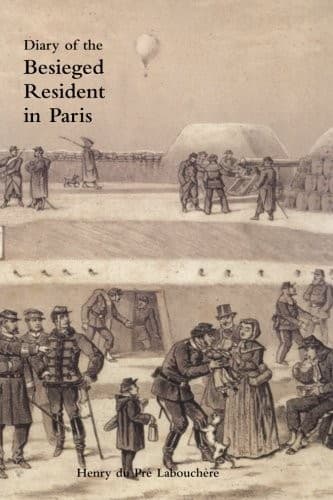
Diary of the Besieged Resident in ParisLabouchere, Henry Du Pré
History
Diary of the Besieged Resident in Paris
Labouchere, Henry Du Pré
Franco-Prussian War, 1870-1871; Paris (France) -- History -- Siege, 1870-1871 -- Personal narratives
Some German officers who are prisoners on parole have been insulted in a
restaurant, and for their own safety it has been found necessary to
confine them in La Roquette. I am not surprised at this. French officers
are, of course, incapable of this contemptible conduct, and it must be
owned that the majority of the Parisians have not, under the trying
circumstances in which they find themselves, lost that courtesy which is
one of the peculiar attributes of the nation. But there is a scum, who
lived from hand to mouth during the Empire, and which infests the
restaurants and the public places. Some of them wear the uniform of the
National Guard; others have attached themselves to the ambulances; and
all take very good care not to risk their precious lives. I was
peaceably dining last night in a restaurant; a friend with whom I had
been talking English had left me, and I found myself alone with four of
these worthies, who were dining at a table near me. For my especial
benefit they informed each other that all strangers here were outlaws
from their own country, and that the Americans and Italians who have
established ambulances were in all probability Prussian spies. As I took
no notice of these startling generalities, one of them turned to me and
said, "You may look at me, sir, but I assert before you that Dr. Evans,
the ex-dentist of the Emperor, was a spy." I quietly remarked, that not
having the honour to know Dr. Evans, and being myself an Englishman,
whilst the Doctor is an American, I was not responsible for him. "You
are a Greek," observed another; "I heard you talk Greek just now." I
mildly suggested that his knowledge of foreign tongues was, perhaps,
somewhat limited. "Well, if you are not a Greek," he said, "I saw you
the other morning near the Ambulance of the Press, to which I belong,
and so you must be a spy." "If you are an Englishman," cried his friend,
"why do you not go back to your own country, and fight Russia?" I
replied that the idea was an excellent one, but that it might, perhaps,
be difficult to pass through the Prussian lines. "The English Ambassador
is a friend of mine, and he will give you a pass at my request,"
answered the gentleman who had mistaken English for Greek. I thanked
him, and assured him that I should esteem it a favour if he would obtain
from his friend Lord Lyons this pass for me. He said he would do so, as
it would be well to rid Paris of such vermin as myself and my
countrymen. He has not yet, however, fulfilled his promise. Scenes such
as these are of frequent occurrence at restaurants; bully and coward are
generally synonymous terms; any scamp may insult a foreigner now with
perfect impunity, for if the foreigner replies he has only to denounce
him as a spy, when a crowd will assemble, and either set on him or bear
him off to prison. While, as I have already said, nothing can be more
courteous than the conduct of French officers, French gentlemen, and,
Public-domain text, read in full here on John Shaqi.
Reviews
Reviews
No reviews yet
Be the first to share your thoughts on this work.
Elsewhere in the archive
Join the Discussion
Join the discussion
Sign in to leave a comment or review.
Sign InorCreate an account