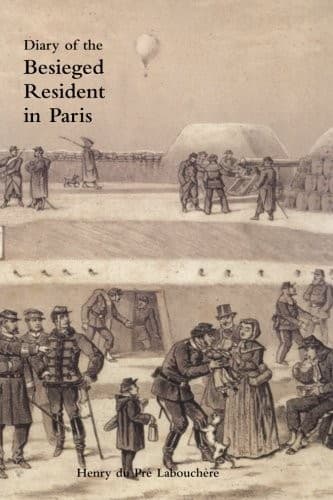
Diary of the Besieged Resident in ParisLabouchere, Henry Du Pré
History
Diary of the Besieged Resident in Paris
Labouchere, Henry Du Pré
Franco-Prussian War, 1870-1871; Paris (France) -- History -- Siege, 1870-1871 -- Personal narratives
Military matters remain _in statu quo_. The army is camped in the wood
of Vincennes. The forts occasionally fire. The Prussians seem to be of
opinion that our next sortie will be in the plain of Genevilliers, as
they are working hard on their fortifications along their lines between
St. Denis and St. Cloud, and they have replaced the levies of the
smaller States by what we call here "real" Prussians. Our engineer
officers consider that the Prussians have three lines of investment, the
first comparatively weak, the second composed of strategical lines, by
which a force of 40,000 men can be brought on any point within two
hours; the third consisting of redoubts, which would prevent artillery
getting by them. To invest a large town, say our officers, is not so
difficult a task as it would appear at first sight. Artillery can only
move along roads, and consequently all that is necessary is to occupy
the roads solidly. General Blanchard has been removed from his command,
and is to be employed in the Third Army under Vinoy. His dispute with
Ducrot arose from a remark which the latter made respecting officers who
did not remain with their men after a battle; and as Blanchard had been
in Paris the day before, he took this general stricture to himself.
Personalities of a very strong nature were exchanged between the two
warriors, and it was thought well that henceforward they should, as much
as possible, be kept apart. General Fave also, who commanded the redoubt
near Joinville, which arrested the advance of the Prussians on the
second battle of Villiers, has "had words." It appears that he declined
to obey an order which was forwarded to him, on the ground of its
absurdity, saying that he was responsible to his conscience.
Indiscipline has been the curse of the French army since the
commencement of the war, and it will continue to be so to the end.
During the siege there have been many individual traits of heroism, but
the armed force has been little better than a mob, and Trochu has not
had the moral courage to enforce his will on his generals. Ducrot says
that he is determined to take the war battalions of the National Guards
under fire at the next sortie, but whether he will succeed remains to be
seen. In these marching battalions there are undoubtedly many brave men,
but both officers and soldiers are inexperienced, and when they see men
falling before them, struck down by an invisible enemy, they lose all
presence of mind.
Public-domain text, read in full here on John Shaqi.
Reviews
Reviews
No reviews yet
Be the first to share your thoughts on this work.
Elsewhere in the archive
Join the Discussion
Join the discussion
Sign in to leave a comment or review.
Sign InorCreate an account