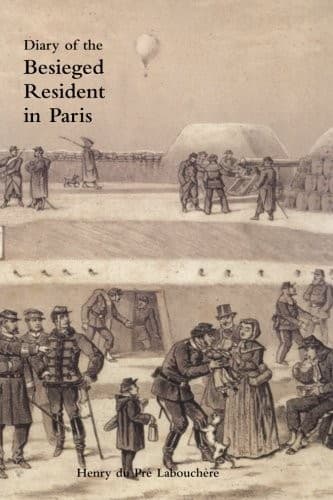
Diary of the Besieged Resident in ParisLabouchere, Henry Du Pré
History
Diary of the Besieged Resident in Paris
Labouchere, Henry Du Pré
Franco-Prussian War, 1870-1871; Paris (France) -- History -- Siege, 1870-1871 -- Personal narratives
the National Guards are outside the walls, and I shall be curious to
learn how they conduct themselves under fire. Far be it from me to say
that they will not fight like lions. If they do, however, it will
surprise most of the military men with whom I have spoken on the
subject. As yet all they have done has been to make frequent "pacts with
death," to perform unauthorised strategical movements to the rear
whenever they have been sent to the front, to consume much liquor, to
pillage houses, and--to put it poetically--toy with Amaryllis in the
trench, or with the tangles of Nearas' hair. Their General, Clement
Thomas, is doing his best to knock them into shape, but I am afraid that
it is too late. There are cases in which, in defiance of the proverb, it
is too late to mend.
Officers in a position to know, assure me that no really serious sortie
will be made, but that after two or three days of the sham fights, such
as took place to-day, the troops will quietly return into Paris. The
object of General Trochu is, they say, to amuse the Parisians, and if he
can by hook or by crook get the National Guard under the mildest of
fires, to celebrate their heroism, in order that they may return the
compliment. I cannot, however, believe that no attempt will be made to
fight a battle; the troops are now massed from St. Denis to the Marne;
within two hours they can all be brought to any point along this line,
and I should imagine that either to-morrow or the next day, something
will be done in the direction of the Forest of Bondy. Trochu, it is
daily felt more strongly, even by calm temperate men, is not the right
man in the right place. He is a respectable literary man, utterly unfit
to cope with the situation. His great aim seems now to be to curry
favour with the Parisian population by praising in all his proclamations
the National Guards, and ascribing to them a courage of which as yet
they have given no proof. This, of course, injures him with the Line and
the Mobiles, who naturally object to their being called upon to do all
the fighting, whilst others are lauded for it. The officers all swear by
Vinoy, and hold the military capacity both of Trochu and Ducrot very
cheap. In the desperate strait to which Paris is reduced, something more
than a man estimable for his private virtues, and his literary
attainments is required. Trochu, as we are frequently told, gave up his
brougham in order to adopt his nephews. Richard III. killed his; but
these are domestic questions, only interesting to nephews, and it by no
means follows that Richard III. would not have been a better defender of
Paris than Trochu has proved himself to be. His political aspirations
and his military combinations are in perpetual conflict. He is ever
sacrificing the one to the other, and, consequently, he fails both as a
general and as a statesman.
Public-domain text, read in full here on John Shaqi.
Reviews
Reviews
No reviews yet
Be the first to share your thoughts on this work.
Elsewhere in the archive
Join the Discussion
Join the discussion
Sign in to leave a comment or review.
Sign InorCreate an account