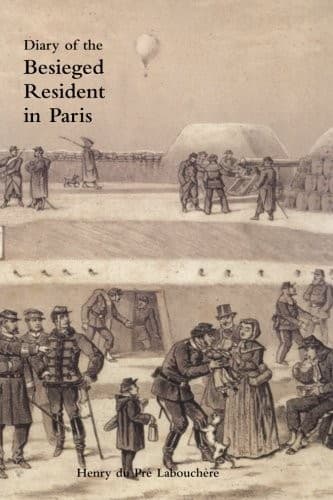
Diary of the Besieged Resident in ParisLabouchere, Henry Du Pré
History
Diary of the Besieged Resident in Paris
Labouchere, Henry Du Pré
Franco-Prussian War, 1870-1871; Paris (France) -- History -- Siege, 1870-1871 -- Personal narratives
The Parisians themselves must perceive that the attempt to frighten
their enemies away by drum-beating and trumpet-blowing has signally
failed. Times have altered since Jericho. It is telling the Prussians
nothing new to inform them that the National Guard are poor troops. For
my part, nothing would give me greater pleasure than to learn some
morning that the German armies round Paris had met with the fate which
overwhelmed Sennacherib and his hosts. I should be delighted to be able
to hope that the town will not eventually be forced to capitulate; but I
cannot conceal from myself the truth that, if no succour comes from
without, it must eventually fall. I blame the French journalists for
perpetually drawing upon their imagination for their facts, and in their
boasts of what France will do, not keeping within the bounds of
probability; but I do not blame them for hoping against hope that their
armies will be successful. I am ready to admit that the Parisians have
shown a most stubborn tenacity, and that they have disappointed their
enemies in not cutting each other's throats; but this is no reason why I
should assert that they are sublime. After all, what is patriotism? The
idea entertained by each nation that it is braver and better and wiser
than the rest of the world. Does not every Englishman feel this to be
true of his own countrymen? It is consequently not absurd that Frenchmen
should think the same of themselves. The French are intensely
patriotic--country with them is no abstraction. They moan over its ruin
as though it were a human being, and far then be it from me to laugh at
them for doing so. When, however, I find persons dressing themselves up
in all the paraphernalia of war, visiting tombs and statues in order to
register with due solemnity that they intend to die rather than yield,
and when, after all this nonsense, these same persons decline to take
their share in the common danger on the score that they have a mother,
or a sister, or a wife, or a child, dependent upon them, and when month
after month they drum and strut up and down the Boulevards, I consider
that they are ridiculous, and I say so. When a man does a silly thing it
is his own fault--not that of the person who chronicles it. Was it wise,
for instance, of General Ducrot to announce a fortnight ago that he was
about to lead his soldiers against the enemy, and that he himself
intended either to conquer or die? Was it wise of General Trochu six
weeks ago to issue a proclamation pledging himself to force the
Prussians to raise the siege of Paris. The Prussians will have read
these manifestoes, and they will form their own estimate respecting
them. That I call them foolish does not "keep up illusions in Germany."
The other day the members of an Ultra club, in the midst of a discussion
respecting the existence of a divinity, determined to decide the
question by a general scrimmage. I think that these patriots might have
been better employed.
Public-domain text, read in full here on John Shaqi.
Reviews
Reviews
No reviews yet
Be the first to share your thoughts on this work.
Elsewhere in the archive
Join the Discussion
Join the discussion
Sign in to leave a comment or review.
Sign InorCreate an account