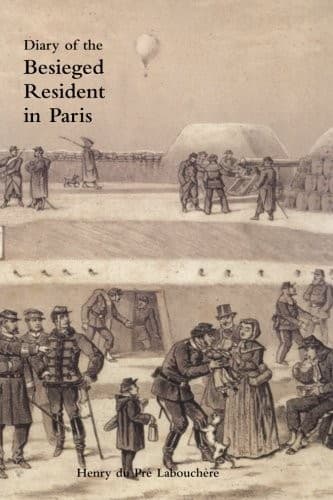
Diary of the Besieged Resident in ParisLabouchere, Henry Du Pré
History
Diary of the Besieged Resident in Paris
Labouchere, Henry Du Pré
Franco-Prussian War, 1870-1871; Paris (France) -- History -- Siege, 1870-1871 -- Personal narratives
to go back immediately. Behind Le Bourget, a little to the right, is a
heavy Prussian battery at Le Blanc Mesnel which entirely commands it.
The Line and the Mobiles bitterly complain that they, and not the
marching battalions, are exposed to every danger. The soldiers, and
particularly those of the Mobiles, say that if they are to go on
fighting for Paris, the Parisians must take their fair share in the
battles. As for the marching battalions, they are, as soldiers, worth
absolutely nothing. The idea of their assaulting, with any prospect of
success, any positions held by artillery, is simply ludicrous. The
system of dividing an army into different categories, is subjected to a
different discipline, is fatal for any united offensive operations. It
is to be hoped that Trochu will at last perceive this, and limit his
efforts to keeping the Prussians out of Paris, and harassing them by
frequent and partial sorties. I hear that General Ducrot wanted to
attempt a second assault of Le Bourget, but this was overruled at a
council of war which was held on Thursday.
_December 26th._
The _Journal Officiel_ announces that military operations are over for
the present, owing to the cold, and that the army is to be brought
inside Paris, leaving outside only those necessary for the defence. This
is a wise measure, although somewhat tardily taken. The Parisians will
no doubt be very indignant; for if they do not like fighting themselves,
they insist that the Line and the Mobiles should have no repose.
M. Felix Pyat gives the following account of Christmas in
England:--"Christmas is the great English fete--the Protestant
Carnival--an Anglo-Saxon gala--a gross, pagan, monstrous orgie--a Roman
feast, in which the vomitorium is not wanting. And the eaters of 'bif'
laugh at us for eating frogs! Singular nation! the most Biblical and the
most material of Europe--the best Christians and the greatest gluttons.
They cannot celebrate a religious fete without eating. On Holy Friday
they eat buns, and for this reason they call it Good Friday. Good,
indeed, for them, if not for God. They pronounce messe mass, and boudin
pudding. Their pudding is made of suet, sugar, currants, and tea. The
mess is boiled for fifteen days, sometimes for six months; then it is
considered delicious. No pudding, no Christmas. The repast is sacred,
and the English meditate over it for six months in advance--they are the
only people who put money in a savings'-bank for a dinner. Poor families
economise for months, and take a shilling to a publican every Saturday
of the year, in return for which on Christmas Day they gorge themselves,
and are sick for a week after. This is their religion--thus they adore
their God." M. Pyat goes on to describe the butchers' shops before
Christmas; one of them, he says, is kept by a butcher clergyman, and
over his door is a text.
Public-domain text, read in full here on John Shaqi.
Reviews
Reviews
No reviews yet
Be the first to share your thoughts on this work.
Elsewhere in the archive
Join the Discussion
Join the discussion
Sign in to leave a comment or review.
Sign InorCreate an account