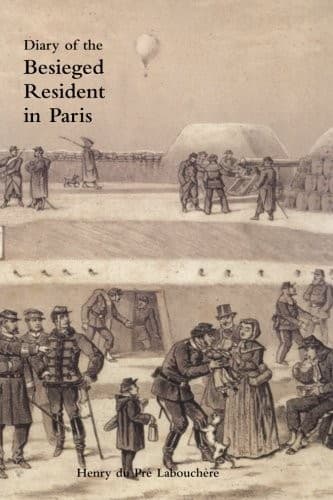
Diary of the Besieged Resident in ParisLabouchere, Henry Du Pré
History
Diary of the Besieged Resident in Paris
Labouchere, Henry Du Pré
Franco-Prussian War, 1870-1871; Paris (France) -- History -- Siege, 1870-1871 -- Personal narratives
get anything out of my pocket I have cautiously to unpin myself, with
the dread of falling to pieces before my eyes. For my food, I allowance
myself, in order to eke out as long as possible my resources. I dine and
breakfast at a second-class restaurant. Cat, dog, rat, and horse are
very well as novelties, but taken habitually, they do not assimilate
with my inner man. Horse, doctors say, is heating; I only wish it would
heat me. I give this description of my existence, as it is that of many
others. Those who have means, and those who have none, unless these
means are in Paris, row in the same boat.
The society at my second-class restaurant is varied. Many are regular
customers, and we all know each other. There are officers who come there
whenever they get leave from outside--hardy, well-set fellows, who take
matters philosophically and professionally. They make the most of their
holiday, and enjoy themselves without much thought of the morrow. Then
there are tradesmen who wear kepis, as they belong to the National
Guard. They are not in such good spirits. Their fortunes are ebbing
away, and in their hearts I think they would, although their cry is
still "no surrender," be glad if all were over. They talk in low tones,
and pocket a lump of the sugar which they are given with their coffee.
Occasionally an ex-dandy comes in. I see him look anxiously around to
make sure that no other dandy sees him in so unfashionable a resort. The
dandy keeps to himself, and eyes us haughtily, for we are too common
folk for the like of him. Traviatas, too, are not wanting in the
second-class restaurant. Sitting by me yesterday was a girl who in times
gone by I had often seen driving in a splendid carriage in the Bois.
Her silks and satins, her jewellery and her carriage, had vanished.
There are no more Russian Princes, no more Boyards, no more Milords to
minister to her extravagances. She was eating her horse as though she
had been "poor but honest" all her life; and as I watched her washing
the noble steed down with a pint of vin ordinaire, I realized the
alteration which this siege was effecting in the condition of all
classes. But the strangest _habitues_ of the restaurant are certain
stalwart, middle-aged men, who seem to consider that their function in
life is to grieve over their country, and to do nothing else for it.
They walk in as though they were the soldiers of Leonidas on the high
road to Thermopylae--they sit down as though their stools were curule
chairs--they scowl at anyone who ventures to smile, as though he were
guilty of a crime--and they talk to each other in accents of gloomy
resolve. When anyone ventures to hint at a capitulation, they bound in
their seats, and cry, _On verra_. Sorrow does not seem to have disturbed
their appetites, and, as far as I can discover, they have managed to
escape all military duty. No human being can be so unhappy, however, as
they look. They remind me of the heir at the funeral of a rich relative.
Public-domain text, read in full here on John Shaqi.
Reviews
Reviews
No reviews yet
Be the first to share your thoughts on this work.
Elsewhere in the archive
Join the Discussion
Join the discussion
Sign in to leave a comment or review.
Sign InorCreate an account