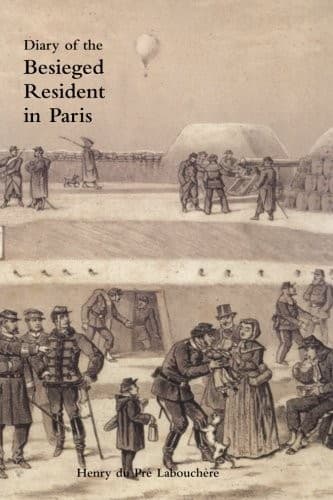
Diary of the Besieged Resident in ParisLabouchere, Henry Du Pré
History
Diary of the Besieged Resident in Paris
Labouchere, Henry Du Pré
Franco-Prussian War, 1870-1871; Paris (France) -- History -- Siege, 1870-1871 -- Personal narratives
A census which has just been made of the population within the lines,
makes the number, exclusive of the Line, Mobiles, and sailors,
2,000,500. No attempt has yet been made to ration the bread, but it is
to be mixed with oats and rice. The mayor of this quarter says that in
this arrondissement--the richest in Paris--he is certain that there is
food for two months. Should very good news come from the provinces, and
it appear that by holding out for two months more the necessity for a
capitulation would be avoided, I think that we should hold on until the
end of February, if we have to eat the soles of our boots. If bad news
comes, we shall not take to this food; but we shall give in when
everything except bread fails, and we shall then consider that our
honour is saved if nothing else is. M. Louis Blanc to-day publishes a
letter to Victor Hugo, in which he tells the Parisians that if they do
capitulate they will gain nothing by it, for the Prussians will neither
allow them to quit Paris, nor, if the war continues, allow food to enter
it.
As yet there are no signs of a real outbreak; and if a successful one
does occur, it will be owing to the weakness of the Government, which
has ample means to repress it. The Parisian press is always adjuring the
working men not to cut either each others' or their neighbours' throats,
and congratulating them on their noble conduct in not having done so.
This sort of praise seems to me little better than an insult. I see no
reason why the working men should be considered to be less patriotic
than others. That they are not satisfied with Trochu, and that they
entertain different political and social opinions to those of the
bourgeoisie, is very possible. Opinions, however, are free, and they
have shown as yet that they are willing to subordinate the expression
of theirs to the exigencies of the national defence. I go a good deal
among them, and while many of them wish for a general system of
rationing, because they think that it will make the provisions last
longer, they have no desire to pillage or to provoke a conflict with the
Government. I regard them myself, in every quality which makes a good
citizen, as infinitely superior to the journalists who lecture them, and
who would do far better to shoulder a musket and to fall into the ranks,
than to waste paper in reviling the Prussians and bragging of their own
heroism. As soldiers, the fault of the working men is that they will not
submit to discipline; but this is more the fault of the Government than
of them. As citizens, no one can complain of them. To talk with one of
them after reading the leading article of a newspaper is a relief. A
French journalist robes himself in his toga, gets upon a pedestal, and
talks unmeaning, unpractical claptrap. A French workman is, perhaps, too
much inclined to regard every one except himself, and some particular
idol which he has set up, as a fool; but he is by no means wanting in
Public-domain text, read in full here on John Shaqi.
Reviews
Reviews
No reviews yet
Be the first to share your thoughts on this work.
Elsewhere in the archive
Join the Discussion
Join the discussion
Sign in to leave a comment or review.
Sign InorCreate an account