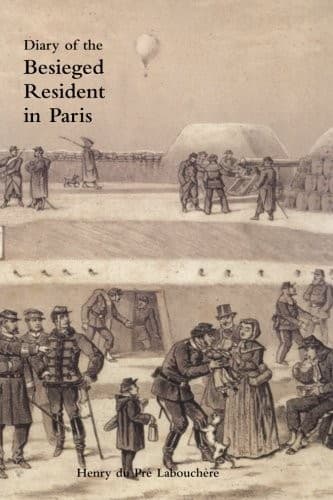
Diary of the Besieged Resident in ParisLabouchere, Henry Du Pré
History
Diary of the Besieged Resident in Paris
Labouchere, Henry Du Pré
Franco-Prussian War, 1870-1871; Paris (France) -- History -- Siege, 1870-1871 -- Personal narratives
do their duty, but that they are doubtful of ultimate success. Come
inside, and talk to some hero who has never yet got beyond the ramparts,
Cato at Utica is a joke to him, Palafox at Saragossa a whining coward.
Since the forts have been bombarded, he has persuaded himself that he is
eating, drinking, and sleeping under the fire of the enemy. "Human
nature is a rum 'un," said Mr. Richard Swiveller; and most assuredly
this is true of French nature. That real civil courage and spirit of
self-sacrifice which the Parisians have shown, in submitting to hardship
and ruin rather than consent to the dismemberment of their country, they
regard as no title to respect. Nothing which does not strike the
imagination has any value in their eyes. A uniform does not make a
soldier; and although they have all arrayed themselves in uniform, they
are far worse soldiers than the peasantry who have been enrolled in the
Mobiles. To tell them this, however, would make them highly indignant.
Military glory is their passion, and it is an unfortunate one. To admire
the pomp and pride of glorious war no more makes a warrior than to
admire poetry makes a poet. The Parisian is not a coward; but his
individuality is so strongly developed that he objects to that
individuality being destroyed by some stray shot. To die with thousands
looking on is one thing; to die obscurely is another. French courage is
not the same as that of the many branches of the great Saxon family. A
Saxon has a dogged stubbornness which gives him an every-day and
every-hour courage. That of the Frenchman is more dependent upon
external circumstances. He must have confidence in his leader, he must
have been encouraged by success, and he must be treated with severity
tempered with judicious flattery. Give him a sword, and let him prance
about on a horse like a circus rider, and, provided there are a
sufficient number of spectators, he will do wonders, but he will not
consent to perish obscurely for the sake of anything or anyone. Trochu
has utterly failed in exciting enthusiasm in those under his command; he
issues many proclamations, but they fail to strike the right chord.
Instead of keeping up discipline by judicious severity, he endeavours to
do so by lecturing like a schoolmaster. And then, since the commencement
of the siege he has been unsuccessful in all his offensive movements. I
am not a military man, but although I can understand the reasons against
a sortie _en masse_, it does appear to me strange that the Prussians are
not more frequently disquieted by attacks which at least would oblige
them to make many a weary march round the outer circle, and would
prevent them from detaching troops for service elsewhere.
Public-domain text, read in full here on John Shaqi.
Reviews
Reviews
No reviews yet
Be the first to share your thoughts on this work.
Elsewhere in the archive
Join the Discussion
Join the discussion
Sign in to leave a comment or review.
Sign InorCreate an account