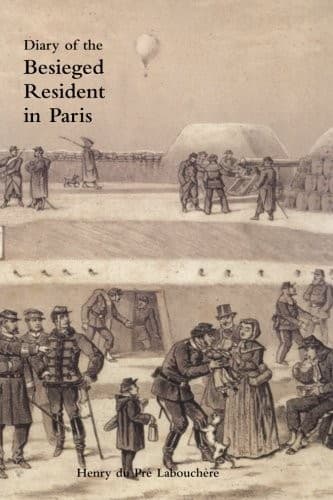
Diary of the Besieged Resident in ParisLabouchere, Henry Du Pré
History
Diary of the Besieged Resident in Paris
Labouchere, Henry Du Pré
Franco-Prussian War, 1870-1871; Paris (France) -- History -- Siege, 1870-1871 -- Personal narratives
extravagance the fashion everywhere; under the Empire, to spend money
was the readiest road to social distinction. The old _bourgeoisie_ still
retained the careful habits of the days of Louis Philippe, and made
fortunes by cheeseparing. Imperial Paris was far above this. Families
were obliged to spend 20 per cent, of their incomes in order to lodge
themselves; shops in favoured quarters were let for fabulous prices, and
charged fabulous prices for their wares. _Cocodettes_ of the Court,
_cocottes_ of the Bois, wives of speculators, shoddy squaws from New
York, Calmues recently imported from their native steppes, doubtful
Italian Princesses, gushing Polish Countesses, and foolish Englishwomen,
merrily raced along the road to ruin. Good taste was lost in tinsel and
glitter; what a thing cost was the only standard of its beauty. Great
gingerbread palaces were everywhere run up, and let even before they
were out of the builder's hands. It was deemed fashionable to drive
about in a carriage with four horses, with perhaps a black man to drive,
and an Arab sitting on the box by his side. Dresses by milliners in
vogue gave a ready currency to their wearers. The Raphael of his trade
gave himself all the airs of a distinguished artist; he received his
clients with vulgar condescension, and they--no matter what their
rank--submitted to his insolence in the hope that he would enable them
to outshine their rivals. Ambassadors' wives and Court ladies used to go
to take tea with the fellow, and dispute the honour of filling his cup
or putting sugar into it. I once went into his shop--a sort of
drawing-room hung round with dresses; I found him lolling on a chair,
his legs crossed before the fire. Around him were a bevy of women, some
pretty, some ugly, listening to his observations with the rapt attention
of the disciples of a sage. He called them up before him like school
girls, and after inspecting them, praised or blamed their dresses. One,
a pretty young girl, found favour in his eyes, and he told her that he
must dream and meditate several days over her, in order to find the
inspiration to make a gown worthy of her. "Why do you wear these ugly
gloves?" he said to another, "never let me see you in gloves of that
colour again." She was a very grand lady, but she slipped off her
gloves, and put them in her pocket with a guilty look. When there was
going to be a ball at Court, ladies used to go down on their knees to
him to make them beautiful. For some time he declined to dress any
longer the wife of a great Imperial dignitary who had not been
sufficiently humble towards him; she came to him in tears, but he was
obdurate, and he only consented at last to make a gown for her on
condition that she would put it on for the first time in his shop. The
Empress, who dealt with him, sent to tell him that if he did not abate
his prices she would leave him. "You cannot," he replied, and in fact
she could not, for she stood by him to the last. A morning dress by this
Public-domain text, read in full here on John Shaqi.
Reviews
Reviews
No reviews yet
Be the first to share your thoughts on this work.
Elsewhere in the archive
Join the Discussion
Join the discussion
Sign in to leave a comment or review.
Sign InorCreate an account