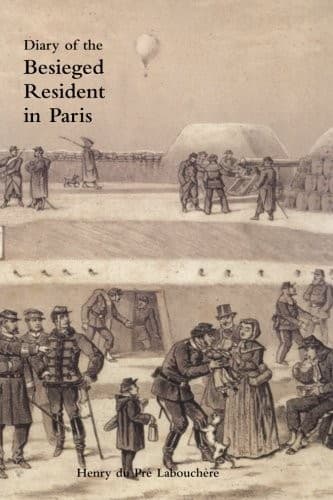
Diary of the Besieged Resident in ParisLabouchere, Henry Du Pré
History
Diary of the Besieged Resident in Paris
Labouchere, Henry Du Pré
Franco-Prussian War, 1870-1871; Paris (France) -- History -- Siege, 1870-1871 -- Personal narratives
The bombardment still continues. The cannon now make one continuous
noise. Each particular discharge cannot be distinguished. The shells
fall on the left bank to a distance of about a mile from the ramparts. A
return of the _Official Journal_ gives 138 wounded and 51 killed up to
the 13th. Among the killed are 18 children and 12 women; among the
wounded, 21 children and 45 women. Waggons and hand-carts packed with
household goods are streaming in from the left to the right bank. In the
bombarded quarters many shops are closed. Some householders have made a
sort of casemate reaching to the first story of their houses; others
sleep in their cellars. The streets are, however, full of people, even
in the most exposed districts; and all the heights from which a view is
to be had of the Prussian batteries are crowded with sightseers. Every
now and then one comes across some house through which a shell has
passed. The public buildings have, as yet, suffered very slightly. The
dome of the Pantheon, which we presume is used as a mark for the aim of
the Prussian artillerymen, has been hit once. The shell has made a round
hole in the roof, and it burst inside the church. In the Jardin des
Plantes all the glass of the conservatories has been shattered by the
concussion of the air, and the orchids and other tropical plants are
dying. Although war and its horrors are thus brought home to our very
doors, it is even still difficult to realise that great events are
passing around us which history will celebrate in its most solemn and
dignified style. Distance in battles lends grandeur to the view. Had the
charge of Balaclava taken place on Clapham Common, or had our gallant
swordsmen replaced the donkeys on Hampstead Heath, even Tennyson would
have been unable to poetise their exploits. When one sees stuck up in an
omnibus-office that omnibuses "will have to make a circuit from _cause
de bombardement_;" when shells burst in restaurants and maim the
waiters; when the trenches are in tea-gardens; and when one is invited
for a sou to look through a telescope at the enemy firing off their
guns, there is a homely domestic air about the whole thing which is
quite inconsistent with "the pomp and pride of glorious war."
Public-domain text, read in full here on John Shaqi.
Reviews
Reviews
No reviews yet
Be the first to share your thoughts on this work.
Elsewhere in the archive
Join the Discussion
Join the discussion
Sign in to leave a comment or review.
Sign InorCreate an account