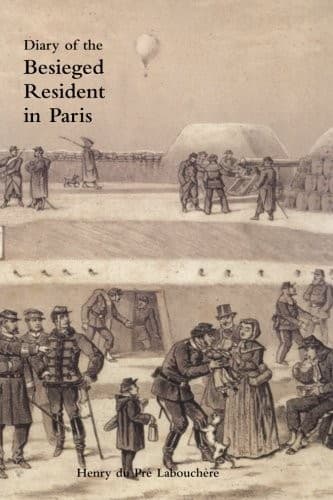
Diary of the Besieged Resident in ParisLabouchere, Henry Du Pré
History
Diary of the Besieged Resident in Paris
Labouchere, Henry Du Pré
Franco-Prussian War, 1870-1871; Paris (France) -- History -- Siege, 1870-1871 -- Personal narratives
has his partisans, and each seems to be of opinion that he himself is a
mighty man of war, and all the others fools. Both Vinoy and Ducrot
declined to attend the Council of War which sat before the late sortie.
They were generals of division, they said, and they would obey orders,
but they would accept no further responsibilities. Ducrot, who was the
_fidus Achates_ of Trochu, is no longer in his good graces. The _Reveil_
of this afternoon, which is usually well-informed on all matters which
concern our Mayors, gives the following account of the meeting of
yesterday: "At three o'clock the meeting took place in the presence of
all the members of the Government. M. Trochu declared formally that he
would fight no more. M. Favre said that the Government was
'disappearing.' M. Favre proposed that the Government should give up its
power to the Mayors. The Mayors refused. The discussion was very
violent. Several propositions, one more absurd than another, were
brought forward by some of the members of the Government. They were not
discussed. As usual, the meeting broke up without any result." The best
man they have is Vinoy; he is honest, disinterested, and determined. It
is to be hoped that if Trochu resigns, he will take his place.
_January 22nd._
So poor Jonah has gone over, and been swallowed up by the whale. He
still remains the head of the civil government, but it only is as a
figure-head. He is an upright man; but as a military chief he has proved
himself a complete failure. He was a man of plans, and never could alter
the details of these plans to suit a change of circumstances. What his
grand plan was, by which Paris was to be saved, no one now, I presume,
ever will know. The plans of his sorties were always elaborately drawn
up; each divisional commander was told in the minutest details what he
was to do. Unfortunately, General Moltke usually interfered with the
proper development of these details--a proceeding which always surprised
poor Trochu--and in the account the next day of his operations, he would
dwell upon the fact as a reason for his want of success. That batteries
should be opened upon his troops, and that reinforcements should be
brought up against them, were trifles--probable as they might seem to
most persons--which filled him with an indignant astonishment. At the
last sortie Ducrot excuses himself for being late at La Malmaison
because he found the road by which he had been ordered to advance
occupied by a long line of artillery, also there by Trochu's orders.
General Vinoy, who has replaced him, is a hale old soldier about seventy
years old. He has risen from the ranks, and in the Crimea was a very
intimate friend of Lord Clyde. When the latter came, a few years before
his death, to Paris, the English Ambassador had prepared a grand
breakfast for him, and had gone to the station to meet him. On the
platform was also Vinoy, who also had prepared breakfast for his old
Public-domain text, read in full here on John Shaqi.
Reviews
Reviews
No reviews yet
Be the first to share your thoughts on this work.
Elsewhere in the archive
Join the Discussion
Join the discussion
Sign in to leave a comment or review.
Sign InorCreate an account