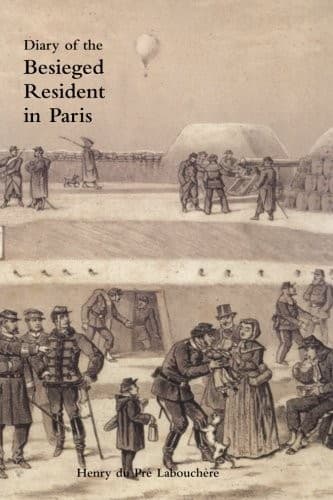
Diary of the Besieged Resident in ParisLabouchere, Henry Du Pré
History
Diary of the Besieged Resident in Paris
Labouchere, Henry Du Pré
Franco-Prussian War, 1870-1871; Paris (France) -- History -- Siege, 1870-1871 -- Personal narratives
purse.[2]
PARIS, _February 7th_.
Rosinante has brought me back with much wheezing from Versailles to
Paris; and with me he brought General Duff, U.S.A., and a leg of mutton.
At the gate of Versailles we were stopped by the sentinels, who told us
that no meat could be allowed to leave the town. I protested; but in
vain. Mild blue-eyed Teutons with porcelain pipes in their mouths bore
off my mutton. The General protested too, but the protest of the citizen
of the Free Republic fared like mine. I followed my mutton into the
guard-house, where I found a youthful officer, who looked so pleasant
that I determined to appeal to the heart which beat beneath his uniform.
I attacked the heart on its weak side. I explained to him that it was
the fate of all to love. The warrior assented, and heaved a great sigh
to his absent Gretchen. I pursued my advantage, and passed from
generalities to particulars. "My lady love," I said, "is in Paris. Long
have I sighed in vain. I am taking her now a leg of mutton. On this leg
hang all my hopes of bliss. If I present myself to her with this token
of my affection, she may yield to my suit. Oh, full-of-feeling,
loved-of-beauteous-women, German warrior, can you refuse me?" He "gazed
on the joint that caused his shame; gazed and looked, then looked
again." The battle was won; the vanquished victor stalked forth,
forgetting the soldier in the man, and gave order that the General, the
Englishman, and the leg of mutton should be allowed to go forth in
peace. Rosinante toiled along towards Paris; we passed through St.
Cloud, now a heap of ruins, and we arrived at the Bridge of Neuilly.
Here our passes were examined by a German official, who was explaining
every moment to a French crowd in his native language that they could
not be allowed to pass into Paris without permits. The crowd was mainly
made up of women, who were carrying in bags, pocket handkerchiefs, and
baskets of loaves, eggs, and butter to their beleaguered friends. "Is it
not too bad of him that he will pretend not to understand French?" said
an old lady to me. "He looks like a fiend," said another lady, looking
up at the good-natured face of the stolid military gaoler. The contrast
between the shrieking, gesticulating, excited French, and the calm,
cool, indifferent air of the German, was a curious one. It was typical
of that between the two races. Having reached Paris, I consigned poor
old long Rosinante to his fate--the knackers, and, with my leg of mutton
under my arm, walked down the Boulevard. I was mobbed, positively
mobbed. "Sir," said one man, "allow me to smell it." With my usual
generosity I did so. How I reached my hotel with my precious burthen in
safety is a perfect mystery. N.B. The mutton was for a friend of mine;
Gretchen was a pious fraud; all being fair in love and war.
Public-domain text, read in full here on John Shaqi.
Reviews
Reviews
No reviews yet
Be the first to share your thoughts on this work.
Elsewhere in the archive
Join the Discussion
Join the discussion
Sign in to leave a comment or review.
Sign InorCreate an account