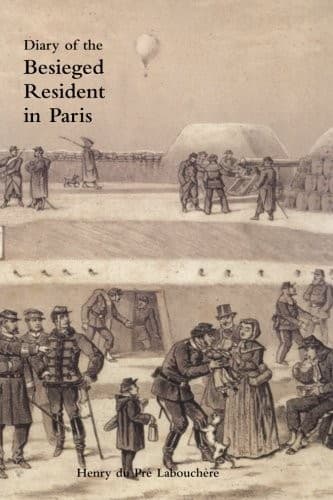
Diary of the Besieged Resident in ParisLabouchere, Henry Du Pré
History
Diary of the Besieged Resident in Paris
Labouchere, Henry Du Pré
Franco-Prussian War, 1870-1871; Paris (France) -- History -- Siege, 1870-1871 -- Personal narratives
I venture to repeat a question which I have already frequently
asked--Where is the gentleman who enjoys an annual salary as British
Consul at Paris? Why was he absent during the siege? Why is he absent
now? Why is a banker, who has other matters to attend to, discharging
his duties? I am a taxpayer and an elector; if "my member" does not
obtain a reply to these queries from the official representative of the
Foreign Office in the House of Commons, I give him fair notice that he
will shake me by the hand, ask after my health, and affect a deep
interest in my reply, in vain at the next general election; he will not
have my vote.
The _Electeur Libre_, the journal of M. Picard, has put forth a species
of political programme, or rather a political defence of the wing of the
Government of National Defence to which that gentleman belongs. For a
French politician to praise himself in his own organ, and to say under
the editorial "we" that he intends to vote for himself, and that he has
the greatest confidence in his own wisdom, is regarded here as nothing
but natural.
PARIS, _February 9th._
"We have been conquered in the field, but we have gained a moral
victory." What this phrase means I have not the remotest idea; but as it
consoles those who utter it, they are quite right to do so. For the last
two days long lines of cannon have issued from the city gates, and have
been, without noise or parade, handed over to the Prussians at Issy and
Sevran. Few are aware of what has taken place, or know that their
surrender had been agreed to by M. Jules Favre. Representations having
been made to Count Bismarck that 10,000 armed soldiers were insufficient
for the maintenance of the peace of the capital, by an additional secret
clause added to the armistice the number has been increased to 25,000.
The greatest ill-feeling exists between the Army and the National Guards
in the most populous quarters. A general quartered in one of the outer
faubourgs went yesterday to General Vinoy, and told him that if he and
his men were to be subjected to insults whenever they showed themselves
in the streets, he could not continue to be responsible for either his
or their conduct. Most persons of sense appear to consider that the
armistice was an error, and that the wiser policy would have been to
have surrendered without conditions. M. Jules Favre is blamed for not
having profited by the occasion, to disarm the National Guards. Many of
their battalions, as long as they have arms, and receive pay for doing
nothing, will be a standing danger to order. The sailors have been paid
off; and the fears that were entertained of their getting drunk and
uproarious have not been confirmed. They are peaceably and sentimentally
spending their money with the "black-eyed Susans" of their affections.
The principal journalists are formally agitating the plan of a combined
movement to urge the population to protest against the Prussian
Public-domain text, read in full here on John Shaqi.
Reviews
Reviews
No reviews yet
Be the first to share your thoughts on this work.
Elsewhere in the archive
Join the Discussion
Join the discussion
Sign in to leave a comment or review.
Sign InorCreate an account