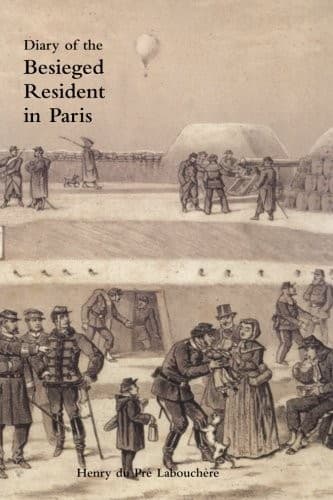
Diary of the Besieged Resident in ParisLabouchere, Henry Du Pré
History
Diary of the Besieged Resident in Paris
Labouchere, Henry Du Pré
Franco-Prussian War, 1870-1871; Paris (France) -- History -- Siege, 1870-1871 -- Personal narratives
card, and wrote his name; he then handed to the central employe his list
of names, folded up. This the employe put into the box. About thirty
National Guards were on duty in or about the room. The box will remain
on the table until to-night, and the National Guards during this time
will not lose sight of it; they will then carry it to the Hotel de
Ville, where it, and all other voting boxes, will be publicly opened,
the votes counted up, and the result, as soon as it is ascertained,
announced. How very un-English, some Briton will observe. I can only say
that I regret it is un-English. Our elections are a disgrace to our
civilisation, and to that common-sense of which we are for ever boasting
that we possess so large a share. Last year I was in New York during a
general election; this year I am in Paris during one; and both New York
and Paris are far ahead of us in their mode of registering the votes of
electors.
FOOTNOTE:
[Footnote 2: Several complaints having been received from Germans
respecting these charges against the German armies, the following
extract from an Article--quoted by the _Pall Mall Gazette_--in his new
paper _Im Neuen Reich_, by the well-known German author, Herr Gustav
Freytag, will prove that they are not unfounded:--"Officers and
soldiers," he says, "have been living for months under the bronze
clocks, marble tables, damask hangings, artistic furniture,
oil-paintings, and costly engravings of Parisian industry. The
musketeers of Posen and Silesia broke up the velvet sofas to make soft
beds, destroyed the richly inlaid tables, and took the books out of the
book-cases for fuel in the cold winter evenings.... It was lamentable to
see the beautiful picture of a celebrated painter smeared over by our
soldiers with coal dust, a Hebe with her arms knocked off, a priceless
Buddhist manuscript lying torn in the chimney grate.... Then people
began to think it would be a good thing to obtain such beautiful and
tasteful articles for one's friends. A system of 'salvage' was thus
introduced, which it is said even eminent and distinguished men in the
army winked at. Soldiers bargained for them with the Jews and hucksters
who swarm at Versailles; officers thought of the adornment of their own
houses; and such things as could be easily packed, such as engravings
and oil-paintings, were in danger of being cut out of their frames and
rolled up for home consumption." Herr Freytag then points out that these
articles are private property, and that the officers and soldiers had no
right to appropriate them to their own use. "We are proud and happy," he
concludes, addressing them, "at your warlike deeds; behave worthily and
honourably also as men. Come back to us from this terrible war with pure
consciences and clean hands."]
CHAPTER XX.
CALAIS, _February 10th._
Public-domain text, read in full here on John Shaqi.
Reviews
Reviews
No reviews yet
Be the first to share your thoughts on this work.
Elsewhere in the archive
Join the Discussion
Join the discussion
Sign in to leave a comment or review.
Sign InorCreate an account