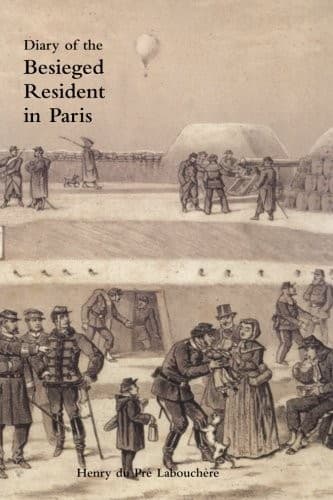
Diary of the Besieged Resident in ParisLabouchere, Henry Du Pré
History
Diary of the Besieged Resident in Paris
Labouchere, Henry Du Pré
Franco-Prussian War, 1870-1871; Paris (France) -- History -- Siege, 1870-1871 -- Personal narratives
_Figaro_ yesterday published a "correspondence from Orleans." The
_Official Gazette_ of this morning publishes an official note from the
Prefect of Police stating that this correspondence is "a lie, such as
those which the _Figaro_ invents every day."
_Afternoon._
I have just returned from the Place de l'Hotel de Ville. When I got
there at about two o'clock six or seven thousand manifesters had already
congregated there. They were all, as is the nature of Frenchmen in a
crowd, shouting their political opinions into their neighbours' ears.
Almost all of them were Nationaux from the Faubourgs, and although they
were not armed, they wore a kepi, or some other distinctive military
badge. As well as I could judge, nine out of ten were working men. Their
object, as a sharp, wiry artizan bellowed into my ear, was to force the
Government to consent to the election of a Commune, in order that the
Chassepots may be more fairly distributed between the bourgeois and the
ouvriers, and that Paris shall no longer render itself ridiculous by
waiting within its walls until its provisions are exhausted and it is
forced to capitulate. There appeared to be no disposition to pillage;
rightly or wrongly, these men consider that the Government is wanting in
energy, and that it is the representative of the bourgeoisie and not of
the entire population. Every now and then, some one shouted out "Vive
la Commune!" and all waved their caps and took up the cry. After these
somewhat monotonous proceedings had continued about half an hour,
several bourgeois battalions of National Guards came along the quay, and
drew up in line, four deep, before the Hotel de Ville. They were not
molested except with words. The leading ranks of the manifesters
endeavoured by their eloquence to convince them that they ought not to
prevent citizens peacefully expressing their opinions; but the grocers
stood stolidly to their arms, and vouchsafed no reply. At three o'clock
General Trochu with his staff rode along inside the line, and then
withdrew. General Tamisier then made a speech, which of course no one
could hear. Shortly afterwards there was a cry of "Voila Flourens--Voila
nos amis," and an ouvrier battalion with its band playing the
Marseillaise marched by. They did not halt, notwithstanding the
entreaties of the manifesters, for they were bound, their officers
explained, on a sacred mission, to deposit a crown before the statue of
Strasburg. When I left the Place the crowd was, I think, increasing, and
as I drove along the Rue Rivoli I met several bourgeois battalions
marching towards the Hotel de Ville. I presume, therefore, that General
Trochu had thought it expedient to send reinforcements. "We will come
back again with arms," was the general cry among the ouvriers, and
unless things mend for the better I imagine that they will keep their
word. The line of demarcation between the bourgeois and the ouvrier
battalions is clearly marked, and they differ as much in their opinions
Public-domain text, read in full here on John Shaqi.
Reviews
Reviews
No reviews yet
Be the first to share your thoughts on this work.
Elsewhere in the archive
Join the Discussion
Join the discussion
Sign in to leave a comment or review.
Sign InorCreate an account