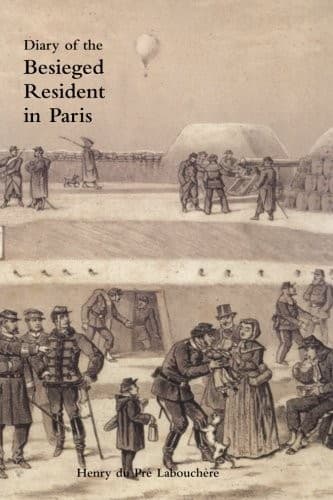
Diary of the Besieged Resident in ParisLabouchere, Henry Du Pré
History
Diary of the Besieged Resident in Paris
Labouchere, Henry Du Pré
Franco-Prussian War, 1870-1871; Paris (France) -- History -- Siege, 1870-1871 -- Personal narratives
On the pure merits of the question, I think that the working men have
reason on their side. They know clearly what they want--to make sorties
and to endeavour to destroy the enemy's works; if this fails--to make
provisions last as long as possible by a system of rationing--and then
to destroy Paris rather than surrender it. The Government and their
adherents are waiters on Providence, and, except that they have some
vague idea that the Army of the Loire will perform impossibilities, they
are contented to live on from day to day, and to hope that something
will happen to avert the inevitable catastrophe. I can understand a
military dictatorship in a besieged capital, and I can understand a
small elected council acting with revolutionary energy; but what I
cannot understand is a military governor who fears to enforce military
discipline, and a dozen respectable lawyers and orators, whose sole idea
of Government is, as Blanqui truly says, to issue decrees and
proclamations, and to make speeches. The only practical man among them
is M. Dorian, the Minister of Public Works, M. Dorian is a hard-headed
manufacturer, and utterly ignoring red tape, clerks, and routine; he has
set all the private ateliers to work, to make cannon and muskets. I have
not yet heard of his making a single speech, or issuing a single
proclamation since the commencement of the siege, and he alone of his
colleagues appears to me to be the right man in the right place. I do
not take my views of the working men from the nonsense which is printed
about them in official and semi-official organs. They are the only class
here which, to use an Americanism, is not "played out." The Government
dreads them as much as the Empire did; but although they are too much
carried away by their enthusiasm and their impulsiveness, they are the
only persons in Paris who appear to have a grain of common sense. "As
for the Army of the Loire," said one of them to me this morning, "no
one, except a fool or a Government employe, can believe that it will
ever be able to raise the siege, and as for all these bourgeois, they
consider that they are heroes because once or twice a week they pass the
night at the ramparts; they think first of their shops, then of their
country." "But how can you imagine that you and your friends would be
able to defeat the Prussians, who are disciplined soldiers?" I asked.
"We can at least try," he replied. I ventured to point out to my friend
that perhaps a little discipline in the ouvrier battalions might not be
a bad thing; but he insisted that the indiscipline was caused by their
distrust of their rulers, and that they were ready to obey their
officers. "Take," he said "Flourens' battalions. They do not, it is
true, march as regularly as the bourgeois, and they have nothing but
kepis and old muskets; but, as far as fighting goes, they are worth all
the bourgeois put together." I do not say that Trochu is not wise to
Public-domain text, read in full here on John Shaqi.
Reviews
Reviews
No reviews yet
Be the first to share your thoughts on this work.
Elsewhere in the archive
Join the Discussion
Join the discussion
Sign in to leave a comment or review.
Sign InorCreate an account