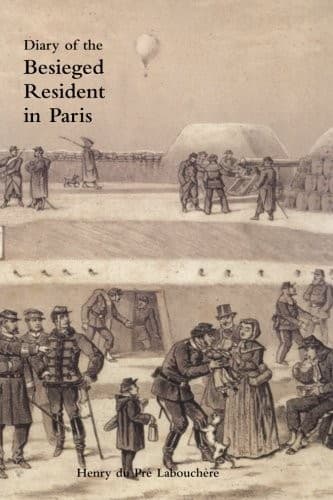
Diary of the Besieged Resident in ParisLabouchere, Henry Du Pré
History
Diary of the Besieged Resident in Paris
Labouchere, Henry Du Pré
Franco-Prussian War, 1870-1871; Paris (France) -- History -- Siege, 1870-1871 -- Personal narratives
to communicate his opinion to his neighbour, for he would be regarded as
a traitor and a liar. The Bostonians believe that Boston is the "hub of
the universe," and the Parisian is under the impression that his city is
a species of sacred Ark, which it is sacrilege to touch. To bombard
London or Berlin would be an unfortunate necessity of war, but to fire a
shot into Paris is desecration. For a French army to live at the expense
of Germany is in the nature of things; for a German army to live at the
expense of Frenchmen is a barbarity which the civilised world ought to
resent. If the result of the present campaign is to convince Frenchmen
that, as a nation, they are neither better nor worse than other nations,
and to convince Parisians that Paris enjoys no special immunity from the
hardships of war, and that if it sustains a siege it must accept the
natural consequences, it will not have been waged in vain, but will
materially conduce to the future peace of the world. As yet--I say it
with regret--for I abominate war and Prussians, and there is much which
I like in the French--this lesson has not been learnt. Day by day I am
becoming more convinced that a lasting peace can only be signed in
Paris, and that the Parisians must be brought to understand by hard
experience that, if victory means an accession of military glory, defeat
means humiliation, and that the one is just as possible as the other. If
the siege were raised to-morrow, the occupation of Alsace and Lorraine
by an enemy would be disbelieved within six months by this vain,
frivolous populace; and even if the German army does ever defile along
the Boulevards, I shall not be surprised if we are told, as soon as they
have withdrawn, that they never were there. Shut up in this town with
its inhabitants, my sympathies are entirely on their side, but my reason
tells me that Bismarck is right in insisting upon treating in Paris. Let
him, if he can, come in here; let him impose upon France such a war
indemnity, that every man, woman, and child in the country will curse
the folly of this war for the next fifty years; and let him give up his
scheme of annexation, and he will then have acted in the interests of
Europe, and ultimately in those of France herself. Prussia, after the
battle of Jena, was as low as France is now. Napoleon stripped her of
her provinces, and she acceded to the treaty of her spoliation, but at
the first favourable opportunity she protested her signature, and the
world has never blamed her for so doing. France, if she is deprived of
Alsace, will do the same. If she signs the treaty, it will only be
binding on her until she is strong enough to repudiate it. A treaty of
territorial spoliation imposed by force never has and never will bind a
nation. The peace of Europe will not be lasting if France hawks about
her alliance, and is ready to tender it to any Power who wishes to carry
out some scheme of aggrandisement, and who will aid her to re-conquer
Public-domain text, read in full here on John Shaqi.
Reviews
Reviews
No reviews yet
Be the first to share your thoughts on this work.
Elsewhere in the archive
Join the Discussion
Join the discussion
Sign in to leave a comment or review.
Sign InorCreate an account