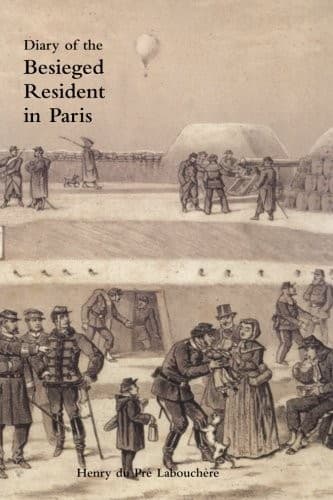
Diary of the Besieged Resident in ParisLabouchere, Henry Du Pré
History
Diary of the Besieged Resident in Paris
Labouchere, Henry Du Pré
Franco-Prussian War, 1870-1871; Paris (France) -- History -- Siege, 1870-1871 -- Personal narratives
We are told that the ex-Emperor has issued a proclamation, _urbi
orbique_, and that his agents are engaged in London and elsewhere in
intriguing in his behalf. I cannot believe that they have any chance of
gaining adherents to their master's cause in England. That halo of
success which blinded a portion of the English press to the iniquities
which were concealed beneath the Imperial purple has now disappeared.
The publication of the papers discovered in the Tuileries has stripped
despotism of its tinsel, and has revealed the vile and contemptible arts
by which a gallant nation has been enslaved. The Government of Napoleon,
as Mr. Gladstone said of that of Bomba, "was a negation of God upon
earth." His councillors were bold bad men, ever plotting against each
other, and united alone in a common conspiracy to grow rich at the
expense of their country, _creverunt in exitio patriae_. His court was
the El Dorado of pimps and parasites, panders and wantons. For eighteen
long years he retained the power, which he had acquired through perjury
and violence, by pandering to the baser passions of his subjects, and by
an organized system of fraud, mendacity, and espionnage. Beneath his
blighting rule French women only sought to surpass each other in
reckless extravagance, and Frenchmen lost the courage which had half
redeemed their frivolity. Honest citizens there were, indeed, who
protested against these Saturnalia of successful villany and rampant
vice, but few listened to their warnings. They were jeered at by the
vulgar, fined, imprisoned, or banished by Ministers and Magistrates. All
that was good, noble, and generous in the nation withered in the
uncongenial atmosphere. The language of Pascal and of Corneille became
the medium of corrupting the minds of millions. The events of the day
were some actress who had discovered a new way to outrage decency, or
some new play which deified a prostitute or an adulteress. Paris became
the world's fair, to which flocked the vain, the idle, and the debauched
from all corners of the globe. For a man to be rich, or for a woman to
find favour in the eyes of some Imperial functionary, were ready
passports to social recognition. The landmarks between virtue and vice
were obliterated. The Court lady smiled in half-recognition on the
courtezan, and paid her homage by endeavouring to imitate her dress and
her manners. Cardsharpers and stockjobbers, disreputable adventurers and
public functionaries were intimate friends. No one, able to insult
modest industry by lavish ostentation, was asked how he had acquired his
wealth. Honour and honesty were prejudices of the past. What has been
the consequence? It is a comment upon despotism, which I hope will not
be lost upon those who extol the advantages of personal government, and
who would sacrifice the liberty of all to the concentrated energy of
one. The armies of France have been scattered to the winds; the
Public-domain text, read in full here on John Shaqi.
Reviews
Reviews
No reviews yet
Be the first to share your thoughts on this work.
Elsewhere in the archive
Join the Discussion
Join the discussion
Sign in to leave a comment or review.
Sign InorCreate an account