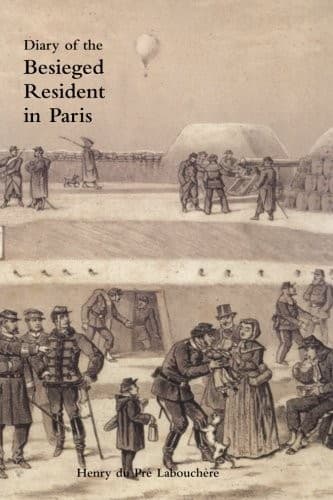
Diary of the Besieged Resident in ParisLabouchere, Henry Du Pré
History
Diary of the Besieged Resident in Paris
Labouchere, Henry Du Pré
Franco-Prussian War, 1870-1871; Paris (France) -- History -- Siege, 1870-1871 -- Personal narratives
The situation also of Bazaine is
proved to be excellent. _Quem Dem, &c._
Two of the mayors have ordered all crucifixes to be removed from the
ambulances in their arrondissements. Their conduct is almost universally
blamed. The enlistment of the Amazons, notwithstanding the efforts of
the Government, still continues. The pretty women keep aloof from the
movement; the recruits who have already joined are so old and ugly that
possibly they may act upon an enemy like the head of Medusa.
_October 17th._
The newspapers to-day almost universally blame the arrest of M.
Portales. This gentleman, with M.E. Picard, started, just before the
siege commenced, a paper called _L'Electeur Libre_. It was thought that
M. Picard's position as a member of the Government rendered it
impossible for him to remain the political director of a newspaper, so
he withdrew, but appointed his brother as his successor. This did not
please M. Portales, who with most of the staff left the _Electeur
Libre_, and founded _La Verite_. It is, therefore, somewhat suspicious
that this new paper should be the only one whose editor has been
imprisoned for circulating "falsehoods." In the first place, almost
every French newspaper of any circulation trades upon lies; in the
second place, it appears that in this particular case the _Verite_ only
put in the sensational form of questions a letter from the _Times_'
correspondent at Tours. This letter it publishes to-day, and appeals to
the public to judge between M. Portales and M. Picard. The fact is that
this population can neither tell nor hear the truth. The English papers
are one and all in bad odour because they declined to believe in the
Emperor's victories, and if a _Daily News_ comes in here with an account
of some new French reverse, I shall probably be imprisoned. Government
and people have laid down this axiom, "bad news false news." General
Trochu again appears in print in a long circular letter to the
commandants of the corps d'armee and the forts. He desires them each to
send him in a list of forty men who have distinguished themselves, and
their names and no others will appear in the order of the day. "We
have," says the General, "to cause this grand thought, which monarchies
decline to recognise but which the Republic should hold sacred, to
penetrate into the minds of our officers and soldiers--opinion alone can
worthily recompense the sacrifice of a life; remember that if you make a
bad choice of the men you recommend, you will gravely compromise your
responsibility towards me, and at the same time the great principle
which I would have prevail." The General is a very copious writer, and
it seems to me that he would do well to remember that if he can only
drive away the Prussians, he will have time enough afterwards to
introduce his "grand thoughts" into the army. Two things, says Thiers,
impose upon Frenchmen--military glory and profound silence. Trochu has
the first to win, and he apparently scorns the latter.
Public-domain text, read in full here on John Shaqi.
Reviews
Reviews
No reviews yet
Be the first to share your thoughts on this work.
Elsewhere in the archive
Join the Discussion
Join the discussion
Sign in to leave a comment or review.
Sign InorCreate an account