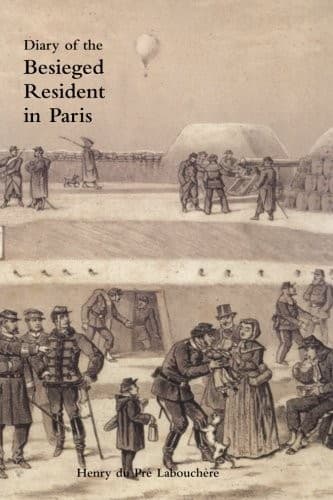
Diary of the Besieged Resident in ParisLabouchere, Henry Du Pré
History
Diary of the Besieged Resident in Paris
Labouchere, Henry Du Pré
Franco-Prussian War, 1870-1871; Paris (France) -- History -- Siege, 1870-1871 -- Personal narratives
It is somewhat amusing to observe how justice is administered when any
dispute arises in the streets. The sergents-de-ville immediately
withdraw, in order not to prejudice the question by their presence. A
sort of informal jury is impanelled, each disputant states his case, and
the one who is thought by the tribunal to be in fault, is either taken
off to prison, or cuffed on the spot. I have bought myself a sugar-loaf
hat of the First Republic, and am consequently regarded with deference.
To-day a man was bullying a child, and a crowd gathered round him; I
happened just then to come up, room was immediately made for me and my
hat, and I was asked to give my opinion as to what ought to be done with
the culprit. I suggested kicking, and as I walked away, I saw him
writhing under the boots of two sturdy executioners, amid the applause
of the spectators. "The style is the man," said Buffon; had he lived
here now he would rather have said "the hat is the man." An English
doctor who goes about in a regulation chimney-pot has already been
arrested twenty-seven times; I, thanks to my revolutionary hat, have
not been arrested once. I have only to glance from under its brim at any
one for him to quail.
_October 18th._
A decree has been issued ordering a company of 150 men to be mobilised
in each battalion of the National Guard. Three of these companies are
together to form a mobilised battalion, and to elect their commander.
The _Journal Officiel_ contains two long reports upon the works of
defence which have been executed since the commencement of the siege.
They give the number of guns on each bastion, and the number of rounds
to each gun, the number of cartridges, and the amount of powder in
store. Unless these reports be patriotic fictions, it seems strange to
publish them in the newspapers, as they must inevitably fall into the
hands of the Prussians. Be this as it may, I do not feel at liberty to
quote from them. General Ducrot publishes a letter protesting against a
statement of the German journals that he escaped from Pont-a-Mousson
when on parole. He asserts that his safe-conduct had been given up, and
that he consequently was free to get away if he could. His evasion is
very similar to that of F. Meagher from Australia. M. Jules Favre
publishes a circular to the French Diplomatic Agents abroad, in reply to
Count Bismarck's report of the meeting at Ferrieres. You will probably
have received it before you get this letter. It is more rhetorical than
logical--goes over the old ground of the war having been declared
against Napoleon rather than against the French nation, and complains
that "the European Cabinets, instead of inaugurating the doctrine of
mediation, recommended by justice and their own interests, by their
inertness authorise the continuation of a barbarous struggle, which is a
disaster for all and an outrage on civilization." M. Jules Favre cannot
emancipate himself from the popular delusions of his country, that
Public-domain text, read in full here on John Shaqi.
Reviews
Reviews
No reviews yet
Be the first to share your thoughts on this work.
Elsewhere in the archive
Join the Discussion
Join the discussion
Sign in to leave a comment or review.
Sign InorCreate an account