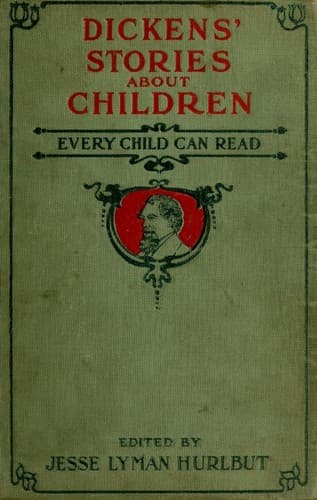
Dickens' Stories About Children Every Child Can ReadDickens, Charles
General
Dickens' Stories About Children Every Child Can Read
Dickens, Charles
Children -- Juvenile fiction; Children's stories, English
The troubles of the Micawbers increased more and more, until at last
they were obliged to leave London. I was very sad at this, for I had
been with them so long that I felt they were my friends, and the
prospect of being once more utterly alone and having to find a lodging
with strangers, made me so unhappy that I determined to endure this sort
of life no longer. The last Sunday the Micawbers were in town I dined
with them. I had bought a spotted horse for their little boy and a doll
for the little girl, and had saved up a shilling for the poor
servant-girl. After I had seen them off the next morning by the coach, I
wrote to Peggotty to ask her if she knew where my aunt, Miss Betsy
Trotwood, lived, and to borrow half-a-guinea; for I had resolved to run
away from Murdstone & Grinby's, and go to this aunt and tell her my
story. I remembered my mother telling me of her visit when I was a baby,
and that she fancied Miss Betsy had stroked her hair gently, and this
gave me courage to appeal to her. Peggotty wrote, enclosing the
half-guinea, and saying she only knew Miss Trotwood lived near Dover,
but whether in that place itself, or at Folkestone, Sandgate, or Hythe,
she could not tell. Hearing that all these places were close together, I
made up my mind to start. As I had received my week's wages in advance,
I waited till the following Saturday, thinking it would not be honest to
go before. I went out to look for someone to carry my box to the coach
office, and unfortunately hired a wicked young man who not only ran off
with the box, but robbed me of my half-guinea, leaving me in dire
distress. In despair, I started off to walk to Dover, and was forced to
sell my waistcoat to buy some bread. The first night I found my way to
my old school at Blackheath, and slept on a haystack close by, feeling
some comfort in the thought of the boys being near. I knew Steerforth
had left, or I would have tried to see him.
On I trudged the next day and sold my jacket at Chatham to a dreadful
old man, who kept me waiting all day for the money, which was only one
shilling and fourpence. I was afraid to buy anything but bread or to
spend any money on a bed or a shelter for the night, and was terribly
frightened by some rough tramps, who threw stones at me when I did not
answer to their calls. After six days, I arrived at Dover, ragged,
dusty, and half-dead with hunger and fatigue. But here, at first, I
could get no tidings of my aunt, and, in despair, was going to try some
of the other places Peggotty had mentioned, when the driver of a fly
dropped his horsecloth, and as I was handing it up to him, I saw
something kind in the man's face that encouraged me to ask once more if
he knew where Miss Trotwood lived.
Public-domain text, read in full here on John Shaqi.
Reviews
Reviews
No reviews yet
Be the first to share your thoughts on this work.
Elsewhere in the archive
Join the Discussion
Join the discussion
Sign in to leave a comment or review.
Sign InorCreate an account