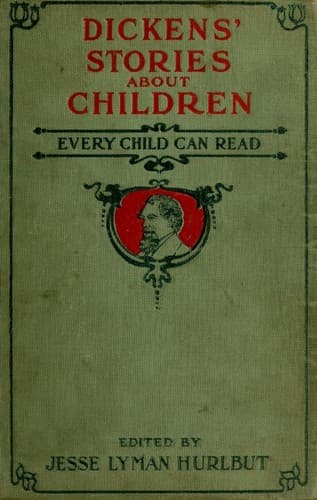
Dickens' Stories About Children Every Child Can ReadDickens, Charles
General
Dickens' Stories About Children Every Child Can Read
Dickens, Charles
Children -- Juvenile fiction; Children's stories, English
The Jew Riah, as well as Lizzie, was always kind and gentle to Jenny
Wren, who called him her godfather. She had a father, who shared her
poor little rooms, whom she called her child; for he was a bad, drunken,
worthless old man, and the poor girl had to care for him, and earn
money to keep them both. She suffered a great deal, for the poor little
bent back always ached sadly, and was often weary from constant work but
it was only on rare occasions, when alone or with her friend Lizzie, who
often brought her work and sat in Jenny's room, that the brave child
ever complained of her hard lot. Sometimes the two girls Jenny helping
herself along with a crutch, would go and walk about the fashionable
streets, in order to note how the grand folks were dressed. As they
walked along, Jenny would tell her friend of the fancies she had when
sitting alone at her work. "I imagine birds till I can hear them sing,"
she said one day, "and flowers till I can smell them. And oh! the
beautiful children that come to me in the early mornings! They are quite
different to other children, not like me, never cold, or anxious, or
tired, or hungry, never any pain; they come in numbers, in long bright
slanting rows, all dressed in white, and with shiny heads. 'Who is this
in pain?' they say, and they sweep around and about me, take me up in
their arms, and I feel so light, and all the pain goes. I know when they
are coming a long way off, by hearing them say, 'Who is this in pain?'
and I answer, 'Oh my blessed children, it's poor me! have pity on me,
and take me up and then the pain will go."
Lizzie sat stroking and brushing the beautiful hair, whilst the tired
little dressmaker leant against her when they were at home again, and as
she kissed her good-night, a miserable old man stumbled into the room.
"How's my Jenny Wren, best of children?" he mumbled, as he shuffled
unsteadily towards her, but Jenny pointed her small finger towards him,
exclaiming--"Go along with you, you bad, wicked old child, you
troublesome, wicked old thing, _I_ know where you have been, _I_ know
your tricks and your manners." The wretched man began to whimper like a
scolded child. "Slave, slave, slave, from morning to night," went on
Jenny, still shaking her finger at him, "and all for this; ain't you
ashamed of yourself, you disgraceful boy?"
"Yes; my dear, yes," stammered the tipsy old father, tumbling into a
corner. Thus was the poor little dolls' dressmaker dragged down day by
day by the very hands that should have cared for and held her up; poor,
poor little dolls' dressmaker! One day when Jenny was on her way home
with Riah, who had accompanied her on one of her walks to the West End,
they came on a small crowd of people. A tipsy man had been knocked down
and badly hurt. "Let us see what it is!" said Jenny, coming swiftly
forward on her crutches. The next moment she exclaimed--"Oh,
gentlemen--gentlemen, he is my child, he belongs to me, my poor, bad old
child!"
Public-domain text, read in full here on John Shaqi.
Reviews
Reviews
No reviews yet
Be the first to share your thoughts on this work.
Elsewhere in the archive
Join the Discussion
Join the discussion
Sign in to leave a comment or review.
Sign InorCreate an account