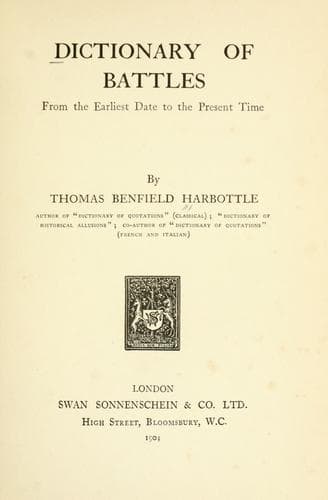
Dictionary of Battles: From the Earliest Date to the Present TimeHarbottle, Thomas Benfield
History
Dictionary of Battles: From the Earliest Date to the Present Time
Harbottle, Thomas Benfield
Battles
Fought August 16, 1513, when a body of French cavalry, who aimed at
relieving Terouënne, which was besieged by the English, under Henry
VIII, and the Imperialists, under Maximilian I, were put to flight by
the allies without striking a blow. The French fled so precipitately
that the action was dubbed the Battle of the Spurs.
Gujerat (Second Sikh War).
Fought February 22, 1849, between the British, 25,000 strong, under Lord
Gough, and 50,000 Sikhs, under Shir Singh. The British artillery,
numbering 84 pieces, broke the Sikh lines, and after resisting for over
two hours, they fled, and were practically annihilated in the pursuit.
Fifty-three guns were taken. The British lost only 92 killed and 682
wounded.
Gunzburg (Campaign of the Danube).
Fought October 9, 1805, when Ney’s corps carried the three bridges over
the Danube, at or near this town, driving off the Austrians with a loss
of 300 killed and wounded, and 1,000 prisoners.
Gwalior (First Mahratta War).
This strong fortress was captured from the Mahrattas, August 3, 1780, by
a British force of about 2,000 men, mostly sepoys, under Captain Popham.
The wall was scaled by two companies of sepoys, under Captain Bruce,
supported by 20 Europeans, and followed by two battalions. The garrison
was completely surprised, and an entrance effected without opposition,
whereupon the place was surrendered to the assailants, who had not lost
a man.
Gwalior (Indian Mutiny).
Fought June 17, 18 and 19, 1858, between a British column under Sir Hugh
Rose, and a large body of rebels, led by the Ranee of Jhansi in person.
On the 17th the mutineers were driven out of the cantonments with heavy
loss, while on the following days the important positions in the town
were captured in succession, until by the evening of the 19th, the
British were in undisputed possession of Gwalior. The Ranee was known to
be amongst the slain, though her body was never found.
H
Haarlem (Netherlands War of Independence).
Public-domain text, read in full here on John Shaqi.
Reviews
Reviews
No reviews yet
Be the first to share your thoughts on this work.
Elsewhere in the archive
Join the Discussion
Join the discussion
Sign in to leave a comment or review.
Sign InorCreate an account