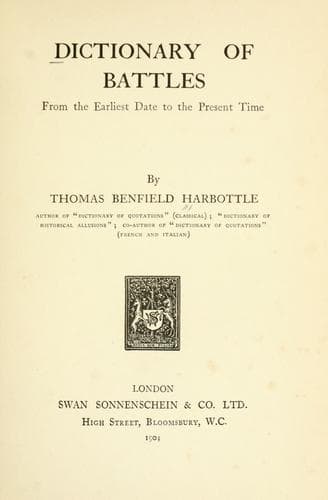
Dictionary of Battles: From the Earliest Date to the Present TimeHarbottle, Thomas Benfield
History
Dictionary of Battles: From the Earliest Date to the Present Time
Harbottle, Thomas Benfield
Battles
This city was besieged by Titus, with 60,000 Romans, in March, 70 A.D.
It was defended with the utmost heroism by the Jews, who were led by the
Zealot faction. At the end of six weeks Titus gained possession of the
suburb of Bezetha, and then by hard fighting, captured position after
position, until on September 8, the resistance of the defenders was
finally overcome. Josephus says that 1,100,000 persons perished in the
siege, but this is doubtless an exaggeration. The Romans after the
capture sold 97,000 into slavery.
Jerusalem (Moslem Invasion of Syria).
Early in 637 Jerusalem was besieged by the Moslems, at first, under Abu
Obeidah, and later by the Khalif Omar. After a defence of four months,
during which scarcely a day passed without a sortie or an assault, the
city was surrendered by the Patriarch Sophronius.
Jerusalem (First Crusade).
The Crusaders, under Godefroi de Bouillon, laid siege to the city, June
7, 1099, and on July 15, it was taken by assault, and for three days was
the scene of a promiscuous massacre, in which 70,000 Moslems perished.
Jerusalem.
On October 2, 1187, the Holy City was besieged by the Saracens, under
Saladin, and after a siege lasting fourteen days, in the course of which
several determined sorties were repulsed, the Moslems forced an
entrance, and Guy de Lusignan, the last King of Jerusalem, surrendered.
The Christians were given forty days to evacuate the city.
Jhansi (Indian Mutiny).
This place, which fell into the hands of the mutineers in June, 1857,
was recaptured by Sir Hugh Rose, who invested it in March, 1858, and
carried the city by assault, April 2.
Jidballi (Somali Expedition).
Fought January 10, 1904, between the Somalis, 5,000 strong, and a small
British and native force, under Sir Charles Egerton. The Somalis’ camp
was attacked, and after a brisk action they were driven out and pursued
by the cavalry for twelve miles, losing 1,000 killed in the fight and
pursuit. The British losses were very small.
Jiron.
Fought February 28, 1829, between the Peruvians, under Lamar, and the
Colombians, under Sucre. The battle was indecisive, both sides claiming
the victory, and it was followed by the signature of peace, September
23.
Jitgurh (Gurkha War).
Fought January 14, 1815, between 4,500 British troops, under General
Wood, and 1,200 Gurkhas, occupying a strong stockade. The British were
led unexpectedly into the zone of fire by a treacherous guide, and
though Wood fought his way to a position from which he could have
carried the stockade, he retired, having suffered considerable loss,
just when the Gurkhas were about to abandon their works.
Jotapata (Jewish War).
Public-domain text, read in full here on John Shaqi.
Reviews
Reviews
No reviews yet
Be the first to share your thoughts on this work.
Elsewhere in the archive
Join the Discussion
Join the discussion
Sign in to leave a comment or review.
Sign InorCreate an account