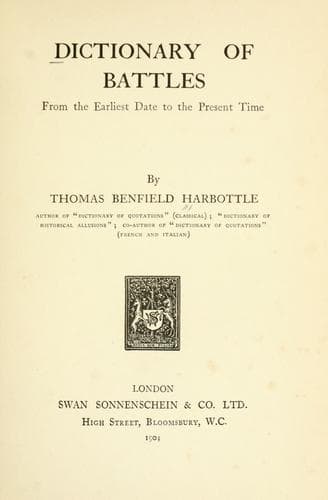
Dictionary of Battles: From the Earliest Date to the Present TimeHarbottle, Thomas Benfield
History
Dictionary of Battles: From the Earliest Date to the Present Time
Harbottle, Thomas Benfield
Battles
Fought October 24 to 26, 1596, between the Turks, under Mohammed III,
and the Imperialists and Transylvanians, under the Archduke Maximilian
and Prince Sigismund of Transylvania. The battle at first went badly for
the Turks, and Mohammed would have fled but for the remonstrances of the
Grand Vizier. In the end, however, they gained the upper hand, and the
Archduke was totally defeated.
Kharisme (Tartar Invasion of Kharismia).
This city, the capital of Kharismia, was besieged by the Tartars under
the three sons of Genghiz Khan, in the summer of 1220. It was most
obstinately defended for a period of seven months by the inhabitants,
under Himartekin, but in February the Tartars mastered the place,
massacring 100,000 persons.
Khartoum (Soudan Campaign).
This city, defended by an Egyptian garrison under General Gordon, was
invested by the Mahdi in the early part of 1884, and, after a gallant
defence, was stormed January 26, 1885. The forerunners of the relieving
force, consisting of the river gunboats under Lord Charles Beresford,
arrived off the city on the 28th, two days too late, and after a brief
engagement with the Mahdist batteries, returned down the river.
Khelat (First Afghan War).
This place, which was defended by a garrison of Beluchis, under Mehrab
Khan, was captured by a British force, 1,000 strong, under General
Willshire, November 13, 1839. The defenders lost 400 killed, including
their leader and 2,000 prisoners. The British lost 37 killed and 107
wounded.
Khojah Pass (First Afghan War).
Fought March 28, 1842, when General England, in an endeavour to relieve
General Nott in Kandahar, marched into the pass with 500 men only,
without waiting for the rest of his brigade, and was defeated by the
Afghans with a loss of 100 killed and wounded, and compelled to retire
to Quetta.
Khoord Kabul Pass (First Afghan War).
While passing through this defile, the British force, under General
Elphinstone, retreating on Jellalabad, was attacked by the Afghans,
January 8, 1842, and lost 3,000, including followers.
Killiecrankie (Jacobite Rising).
Fought July 27, 1689, between 4,500 Royal troops, under General Mackay,
and 2,500 Highland Jacobites, under Dundee. Dundee allowed Mackay to
enter the plain below the pass of Killiecrankie, and then descending
from the heights, fell upon and utterly routed the Royalists, with a
loss of over 2,000 killed and 500 prisoners. The Jacobites lost about
900, but amongst them was Dundee. Mackay on reaching Stirling had only
400 men with the colours.
Kilsyth (Civil War).
Fought August 15, 1645, between the Royalists, under Montrose, and the
Covenanters, under Baillie. The Royalists won a signal victory,
Baillie’s infantry, 6,000 in number, being cut down almost to a man.
Kimberley (Second Boer War).
Public-domain text, read in full here on John Shaqi.
Reviews
Reviews
No reviews yet
Be the first to share your thoughts on this work.
Elsewhere in the archive
Join the Discussion
Join the discussion
Sign in to leave a comment or review.
Sign InorCreate an account