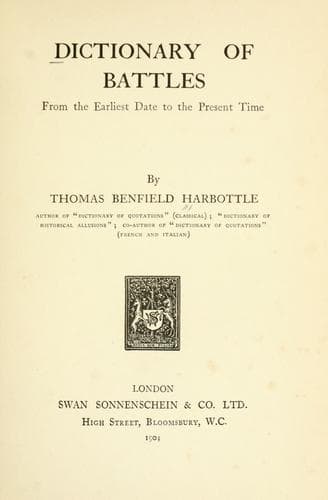
Dictionary of Battles: From the Earliest Date to the Present TimeHarbottle, Thomas Benfield
History
Dictionary of Battles: From the Earliest Date to the Present Time
Harbottle, Thomas Benfield
Battles
Fought October 17, 1346, between the Scottish invading army, under David
II, and the northern levies, under Henry Percy and Ralph Neville. The
Scots were completely routed, with a loss of 15,000 men, and David and
many of his nobles captured.
Newburn (Scottish Wars).
Fought August 28, 1640, between 4,500 English, under Lord Conway, and
the Scottish army, 22,500 strong, under Leslie. Conway endeavoured to
hold the ford of Newburn, near Newcastle, but his raw levies, after a
cannonade of three hours, fled in confusion. Conway was consequently
obliged to evacuate Newcastle, which was occupied by the Scots. The
losses on both sides were small.
Newbury (Civil War).
Fought September 20, 1643, between the Royalists, under Charles I, and
the Parliamentarians, under Essex. The object of Charles was to stop
Essex’s march on London, and though his troops held their ground
throughout the day, he could not be said to have gained a victory, as
during the night he felt himself obliged to abandon his position.
A second indecisive battle was fought at Newbury, October 27, 1644, when
the Royalists, under Charles I, again sustained throughout the day,
without giving ground, the attacks of the Parliamentary army, under
Waller, Manchester, and others, but, as on the previous occasion,
retired during the night.
Newmarket (American Civil War).
Fought May 13, 1864, between 15,000 Federals, under Sigel, and 3,500
Confederates, under Breckenridge. The Confederates, by a rapid flank
movement, fell upon Sigel’s force while on the march, and drove them to
seek shelter in a wood behind their artillery. The guns were then most
gallantly attacked and taken by 250 boys, pupils of the Lexington
Military School, who lost 80 of their number in the charge. Sigel
retired, having lost very heavily in men, and leaving 6 guns in the
enemy’s hands.
New Orleans (Second American War).
This city, held by a garrison of 12,000 Americans, under General
Jackson, was attacked December, 1814, by a British force of 6,000 men,
under General Keane, aided by the fleet. On the 13th the American
warships, lying in the Mississippi, were captured by a boat attack, and
by the 21st the whole of the troops were disembarked. After a few
skirmishes, Sir Edward Pakenham, arrived and took command on the 25th,
and on January 1, 1815, a determined attack was made upon the American
position. This failed, and owing to difficulties as to supplies, the
British retired. On the 7th a final assault took place, but the
assailants were again repulsed, with a loss of 1,500, including
Pakenham, and the expedition then withdrew. At the time of the action
peace had already been concluded, though of course neither party was
aware of the fact.
New Orleans (American Civil War).
Public-domain text, read in full here on John Shaqi.
Reviews
Reviews
No reviews yet
Be the first to share your thoughts on this work.
Elsewhere in the archive
Join the Discussion
Join the discussion
Sign in to leave a comment or review.
Sign InorCreate an account